Moissi apparently wanted to say a few words to the audience after the curtain fell early but was prevented from doing so by the anti-Semitic heckling. The local Social Democratic newspaper Der Vorwärts described the student attacks as a 'manifestation of hatred' (Vorwärts, no. 288, 31 December 1921, pp. 2f.). It is unclear whether the disturbances were planned in advance to provoke a demolition. However, as early as 11 December 1921, members of the Romanian student association 'Arboroasa' had asked the General Inspector of the Arts, Grigori Pantasi, to make the City Theatre available for a concert on 29 December 1921. As this would have clashed with the performance of ‘Die Räuber’, it was agreed with the theatre director, Wilhelm Popp, to bring it forward. Apparently, however, this planned postponement was delayed by forty minutes, as officials from the Finance Directorate had to check the payment of the tax levied on the theatre tickets before the performance of 'Die Räuber' (Vorwärts, ibid.). This meant that the Romanian audience - including high-ranking officials and university professors - had to wait outside the theatre, which led to unrest.
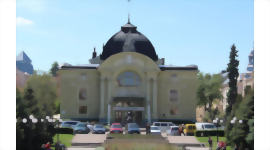
The scandal had far-reaching consequences. In the following days, demonstrations by Romanian students took place at the university and in the theatre, protesting the continued existence of a German theatre in Chernivtsi and demanding that it be transformed into a Romanian stage. The Czernowitzer Allgemeine Zeitung reported that on 1 January 1922, after a meeting of Romanian students in the municipal theatre, attended by university professors, the theatre was declared the Romanian National Theatre. The students put up temporary plaques in the theatre building with the inscriptions 'Teatrul Naţional' and 'Foreign ensembles are no longer allowed to play here' (Czernowitzer Allgemeine Zeitung, no. 1293, 3 January 1922, p. 2). A representative of the Romanian Ministry of the Interior, who had been sent to Chernivtsi to resolve the crisis, called for Popp's dismissal, claiming that he ‘had 'snubbed the Romanians during his entire term of office with his extremely unconciliatory behaviour; the student body, which this time represented the Romanian population, must be offered satisfaction' (interview in: Das Volk, no. 773, 6 January 1922, p. 2). A state commission investigated the events, negotiated the future of the Chernivtsi Municipal Theatre and decided to rename the theatre 'Teatrul Naţional' and to give the primary right of use to a yet to be formed permanent Romanian ensemble.
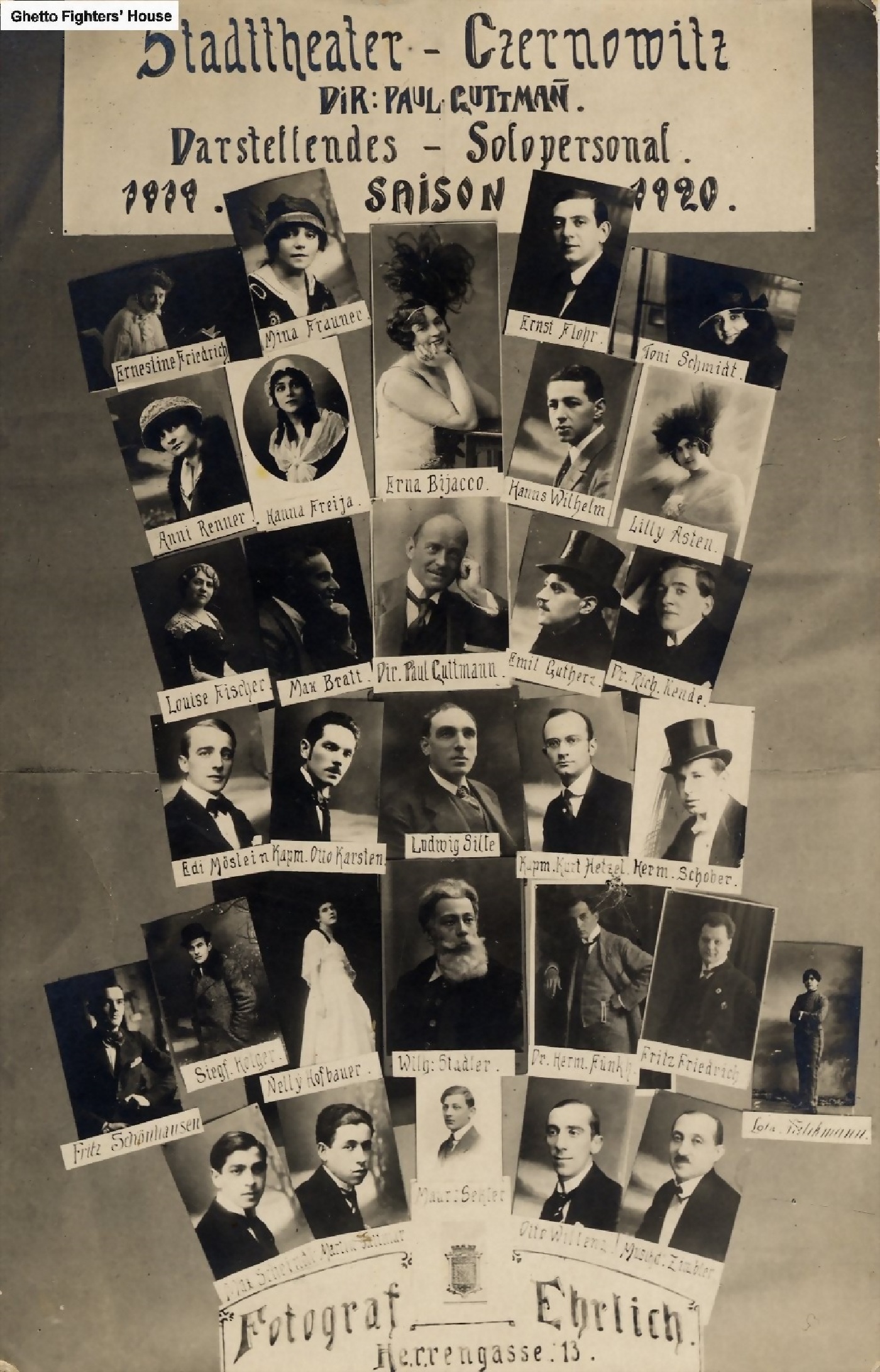
Theatre-historical treatises point out that the era of the German-language stage in the Chernivtsi City Theatre ended with the cancellation of the 'Die Räuber' performance, and the ensemble from then on performed in the Musikverein hall (Georg Drozdowski: Zur Geschichte des Theaters in der Bukowina. In: Franz Lang (Hg.): Buchenland. Hundertfünfzig Jahre Deutschtum in der Bukowina. Munich 1961, pp. 451-472, here pp. 464f). However, as there was no independent Romanian theatre company in Chernivtsi at the time, German-language plays continued to be performed at the theatre after the theatre scandal and the 1921/22 theatre season (the theatre season usually ran from October to April). Popp remained director of the German-language company and negotiated a contract for a shortened season for the 1922/23 theatre season. This was followed by a transitional period in which the German-speaking company shared the stage of the Teatrul Naţional with a Romanian theatre company. As a result, in the autumn of 1922, Max Leonard's Romanian theatre company 'Compania lirică romană' performed mainly operettas in Chernivtsi for several months, during which time they were unable to perform German-language theatre (Czernowitzer Morgenblatt, no. 1228, 30 July 1922, p. 5). This constellation, previously unknown to German-speaking theatre audiences, led to an internal crisis in the German theatre, which manifested itself in criticism of Popp from the press and especially from the 'Czernowitzer Theaterverein', which had been founded in April 1921. After Popp had given guest performances with two ensembles in Bucharest and Sibiu in the autumn of 1922, the German-language theatre season in Chernivtsi was not due to begin until December 1922. As a result, Popp was accused of contractual mismanagement. Apparently, he had agreed with the Ministry of Culture in Bucharest that a German ensemble would perform at the National Theatre for three months, but that 'for the rest of the time no German theatre ensemble would be allowed to perform in Chernivtsi' (Czernowitzer Morgenblatt, no. 1271, 24 September 1922, p. 1). The accusation was all the more serious because the Musikverein hall had already been converted into an 'emergency stage' (ibid.) with funds from the 'Czernowitz Theatre Association'. One reason for the ban on German-language plays was the authorities' desire to popularise Romanian theatre and attract audiences. German and Romanian theatre should 'not compete with each other' (Czernowitzer Morgenblatt, No. 1316), 19 November 1922, p. 4f.).
Unlike in schools and universities, the state could enforce Romanianisation in the theatre, but it could not force the public to accept and attend performances. Therefore, attempts were made to prevent possible disruptive factors, such as the presence of German-language performances during this period. Nevertheless, the Romanian authorities tried to demand the recognition of Romanian theatre as a general civic duty. The Vorwärts identified the attitude of the Romanian cultural official Gavril Rotică as a veiled threat to a 'dissatisfied minority' (Vorwärts, no. 208, 26 September 1922, pp. 2f.). Rotică claimed that the public's ignoring of Romanian theatre was a form of 'passive resistance' and 'springs from a reprehensible feeling of hostility towards the Romanian language'. Vorwärts concluded that the upcoming Romanian theatre season would therefore be 'a test of everyone's feelings towards Romanian culture' and that Rotică was degrading Romanian theatre 'to a loyalty test centre, a kind of artistic-bureaucratic branch of Siguranza'.
The German theatre season was supposed to last until the end of March 1923, but economic difficulties made continuous theatre work hardly possible. Despite contractual agreements, the German theatre was forced to hand over the stage to Romanian ensembles for short guest performances, which necessitated afternoon performances that were not very popular (Czernowitzer Allgemeine Zeitung, No. 1619, 27 February 1923, p. 1). After the theatre was occupied again in February 1923, the wages of the ensemble members could no longer be paid (Czernowitzer Allgemeine Zeitung, no. 1622, 2 March 1923, p. 2). In March 1923, the German-language stage finally disappeared from the Teatrul Naţional. Constantin Berariu, the theatre's general director, then declared that the question of whether non-Romanian nations 'will be given the opportunity to perform on the stage of the National Theatre in the future' (Czernowitzer Allgemeine Zeitung, no. (1628), 9 March 1923, p. 2) had not yet been resolved. By this time, the discourse on the function of Romanian theatre in promoting the cultural assimilation of minorities was already dominant among Romanian cultural workers and the media.
Text: Markus Winkler
Source:
Markus Winkler: Nationale Umbrüche, Antisemitismus und das deutsch-jüdische Verhältnis: Zur Rolle der deutschsprachigen Presse in der Czernowitzer Theaterkrise (1921-1923). In: Deutschsprachige Öffentlichkeit und Presse in Mittelost- und Südosteuropa (1848-1948). Hrsg. von Andrei Corbea-Hoisie, Ion Lihaciu und Alexander Rubel. Jassy, Konstanz: Editura Universităţii / Hartung-Gorre Verlag 2008 (Jassyer Beiträge zur Germanistik XII), S. 461–486.