At first glance, Chernivtsi seemed to lack the social breeding ground for such an initiative. Chernivtsi was not a large city, there was no migration movement and hardly any industrialisation that could have led to social upheaval. On the other hand, there was a relatively strong service society, consisting of civil servants, teachers, employees and members of the professions, with a large Jewish population. In Chernivtsi, therefore, it was mainly this group that attended cultural events, took courses or used the library.
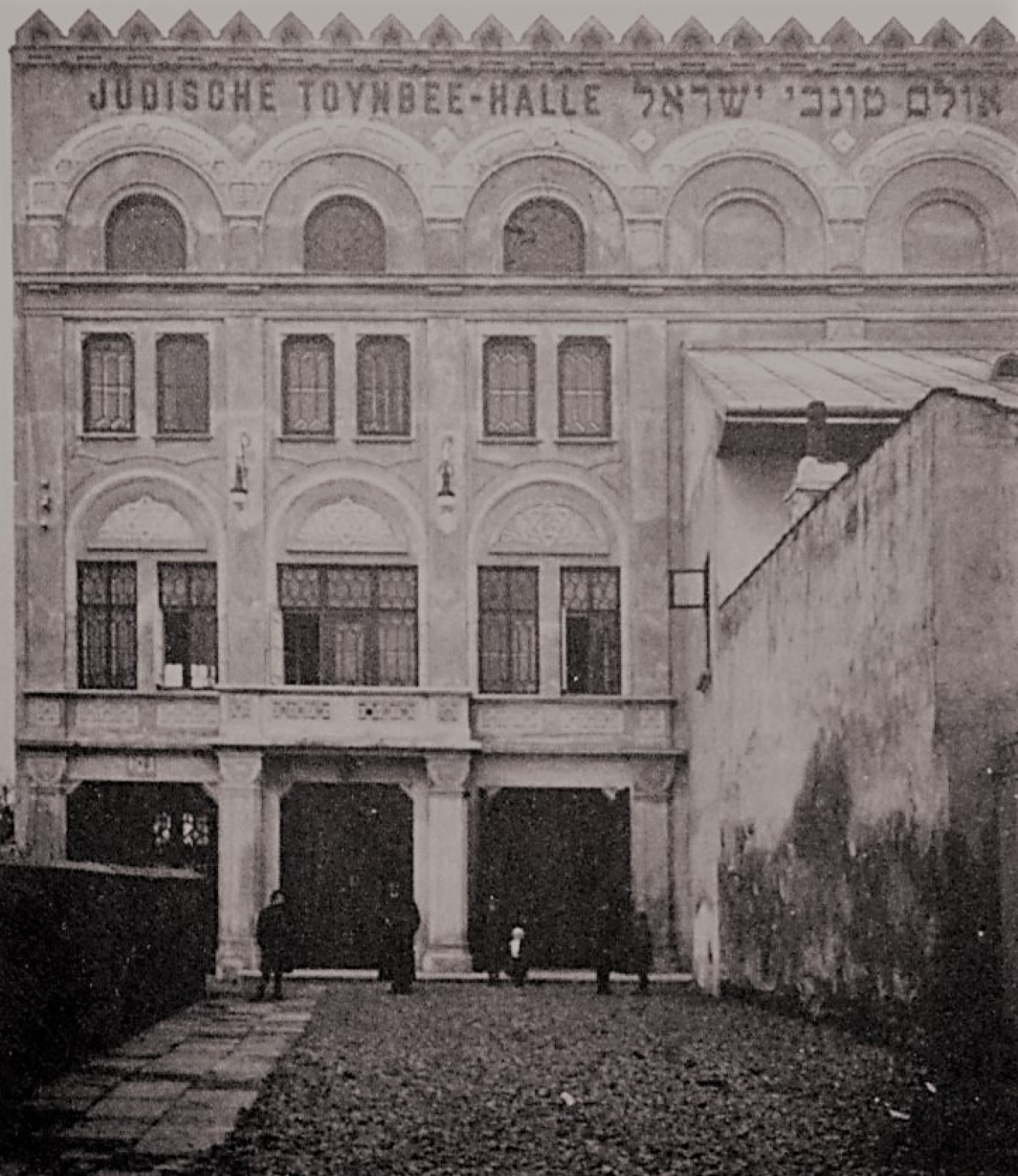
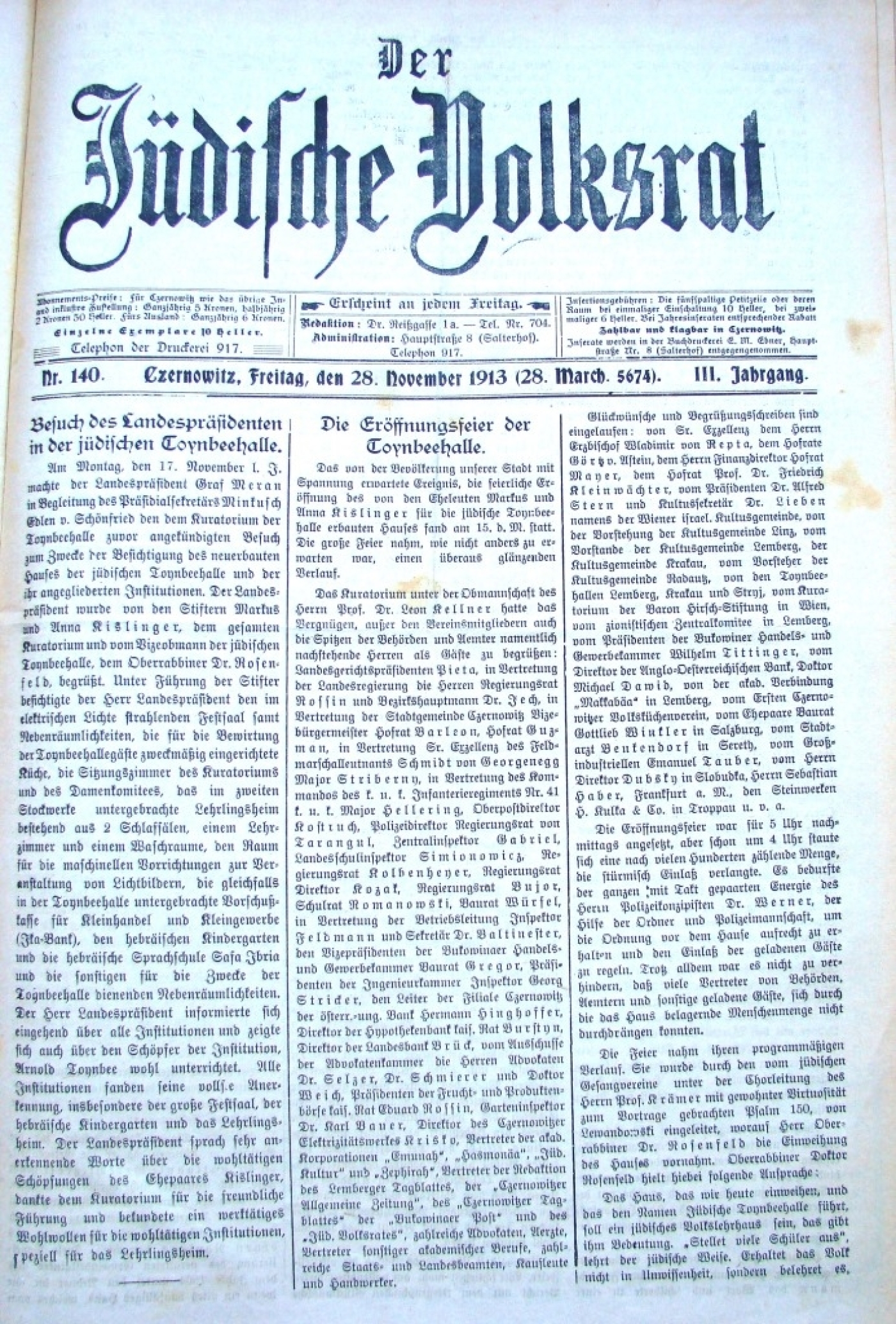
The large, four-storey building took seventeen months to build and, according to a contemporary description, when it opened it had the following rooms: “an electric lighted ballroom with adjoining rooms, the kitchen suitably equipped for the catering of Toynbeehal's guests, the meeting rooms of the Board of Trustees and the Ladies' Committee, the apprentices' dormitory on the second floor, consisting of 2 bedrooms, a classroom and a washroom, a library, a library, a library, a library, a library, and an auditorium, the room for the mechanical equipment for organising slide shows, the advance office for small trade and small business (ICA Bank), also housed in the Toynbee Hall, the Hebrew kindergarten and the Safah Ivriah Hebrew language school [...]”. (The Jewish People's Council, 28 November 1913, p. 1).
The activities of the Jewish Toynbee Hall came to a halt with the outbreak of war in 1914 and were not resumed until 6 December 1919. Lectures on national education and enlightenment and musical performances were announced. Teaching, training courses and the lecture cycles of the Jewish academic associations also continued. The functionality of the building was expanded. The Bukovina Zionist National Committee had its headquarters in the building, and in 1923 a Jewish public library was opened to the public. In June 1928, a new reading room was built to provide access to the international Jewish press. Max Reisch's Jewish Municipal Theatre performed in the ballroom on special occasions, and the Yiddish fable writer Elieser Steinbarg rehearsed his children's plays here. The Safah Ivriah Hebrew language school was also housed in the rear of the building until the 1930s.
Toynbee Hall took on a very different and important function during the war years. After around two-thirds of the Jewish population had been deported to the camps in Transnistria, the institution took on a unique role as an educational centre for Jewish students. It began to educate Jewish children from families who had been granted permission by the Romanian authorities in 1941 to stay in Chernivtsi. Public schools were closed to them, so they were taught in Toynbee Hall, as contemporary witness Abraham Kogan (born in Chernivtsi in 1926) recalls:
“During WWII, in 1942-1943, during what we call the ,Ghetto Period‘, the leaders of the small Cz.[Chernivtsi] Jewish community managed to obtain a special permission from the authorities to use the Toynbee-Halle building for establishing an improvised high school. It was intended to provide secondary school education for teenagers from Jewish families that in 1941 got an ,Autorizatie‘ [Autorisation] and were left to stay in Cz. It was very important to have such school at that time because Jewish families could not afford it to pay for private tuition. How those leaders managed to get such permission is a mystery for me. In hindsight, while the Ghetto system was still in place, the idea to organize such a school was something implausible. Nevertheless, we got excellent and very competent Jewish teachers.” (Abraham Kogan, 25 June 2007, source reference).
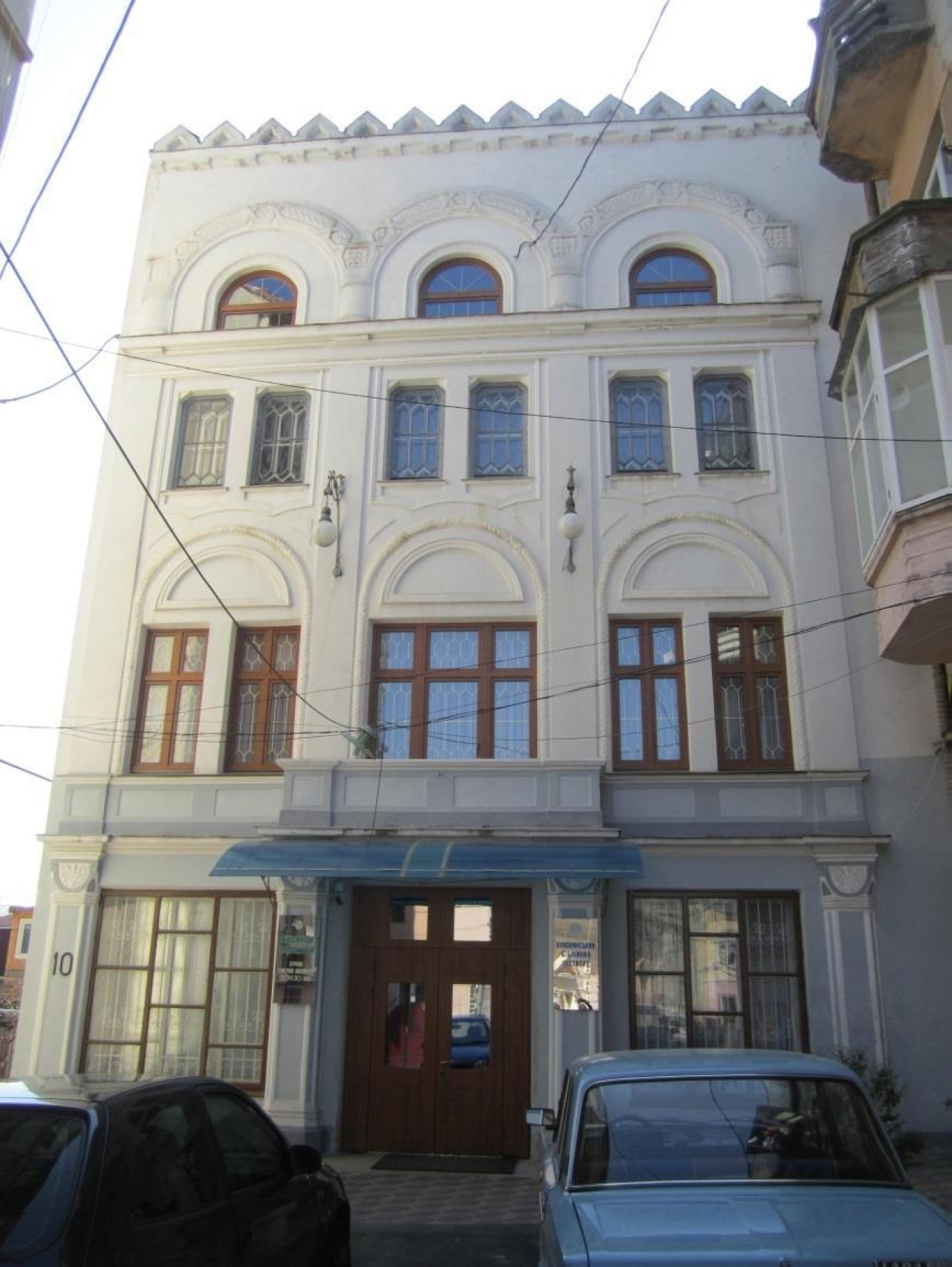
Today the building belongs to an Adventist congregation. The exterior, rooms and layout of the building have remained virtually unchanged.
Text: Markus Winkler
Source:
- Markus Winkler: Toynbee-Halle in Czernowitz 1913: Zur Rekonstruktion einer jüdischen Bildungseinrichtung. In: ders. (Hg.): Partizipation und Exklusion: Zur Habsburger Prägung von Sprache und Bildung in der Bukowina. 1848 – 1918 – 1940. Regensburg 2015 (= Veröffentlichungen des Instituts für deutsche Kultur und Geschichte Südosteuropas an der Ludwig-Maximilians-Universität München 132), S. 215-227