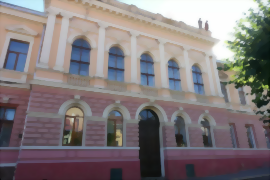
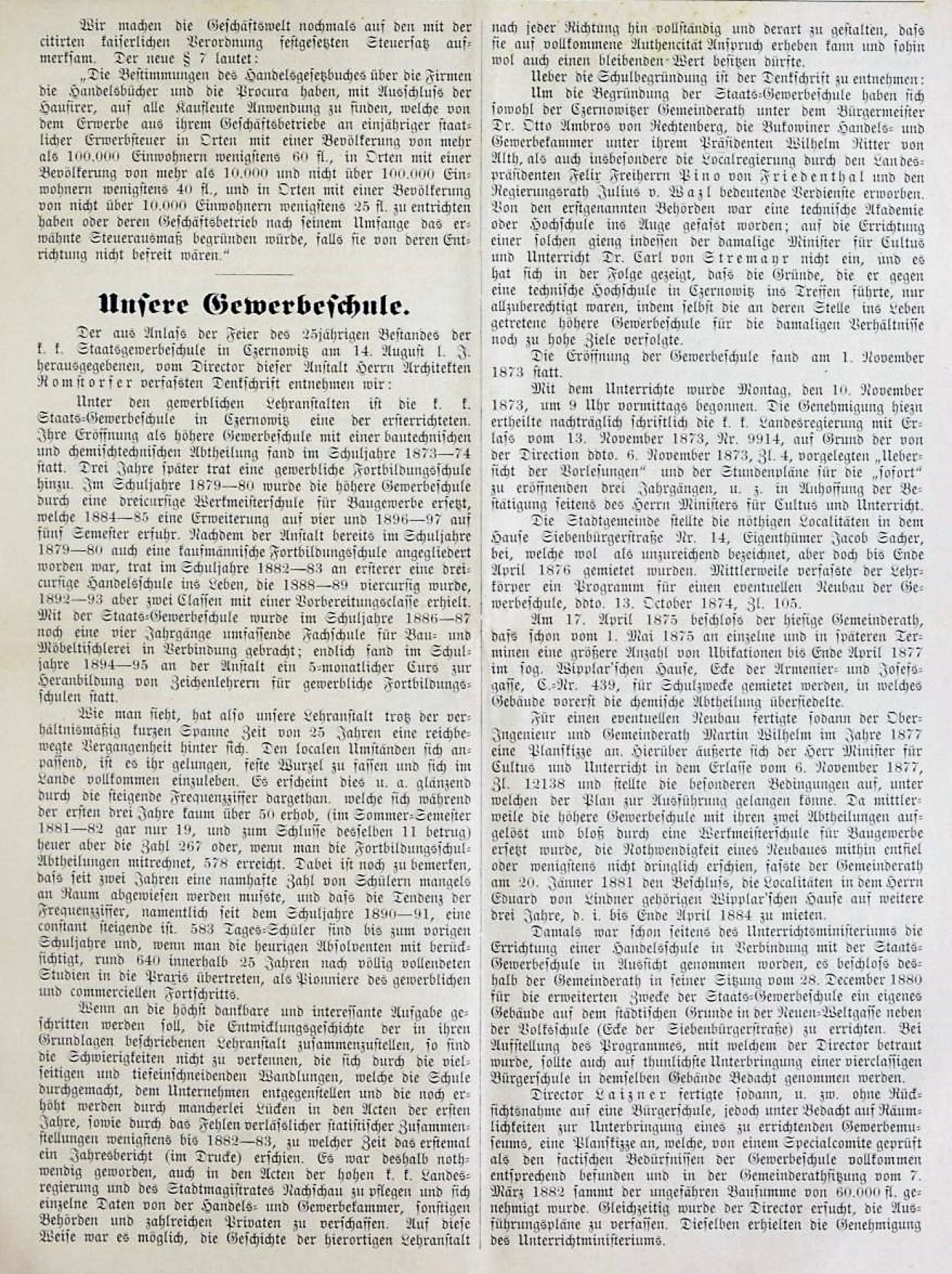
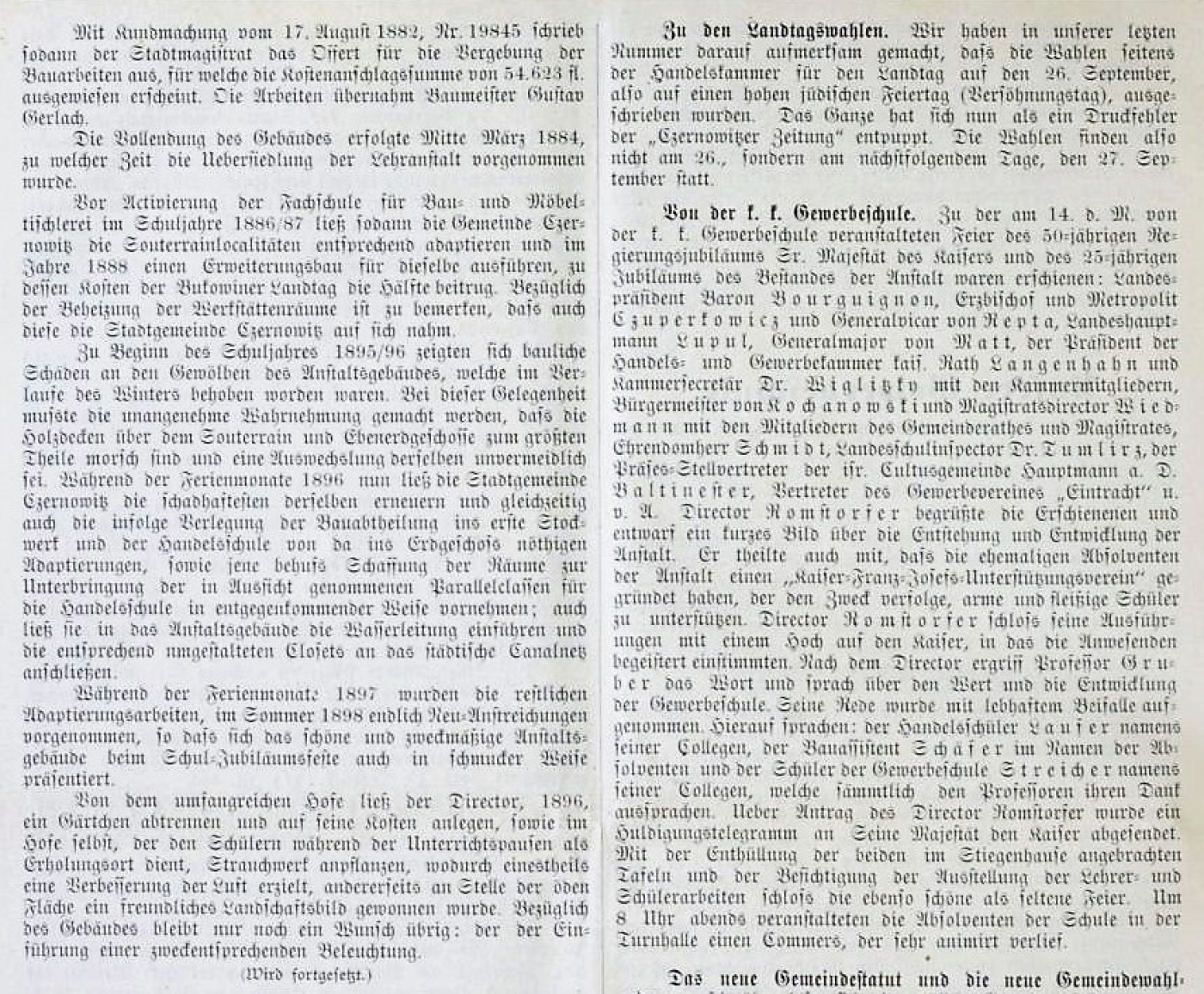
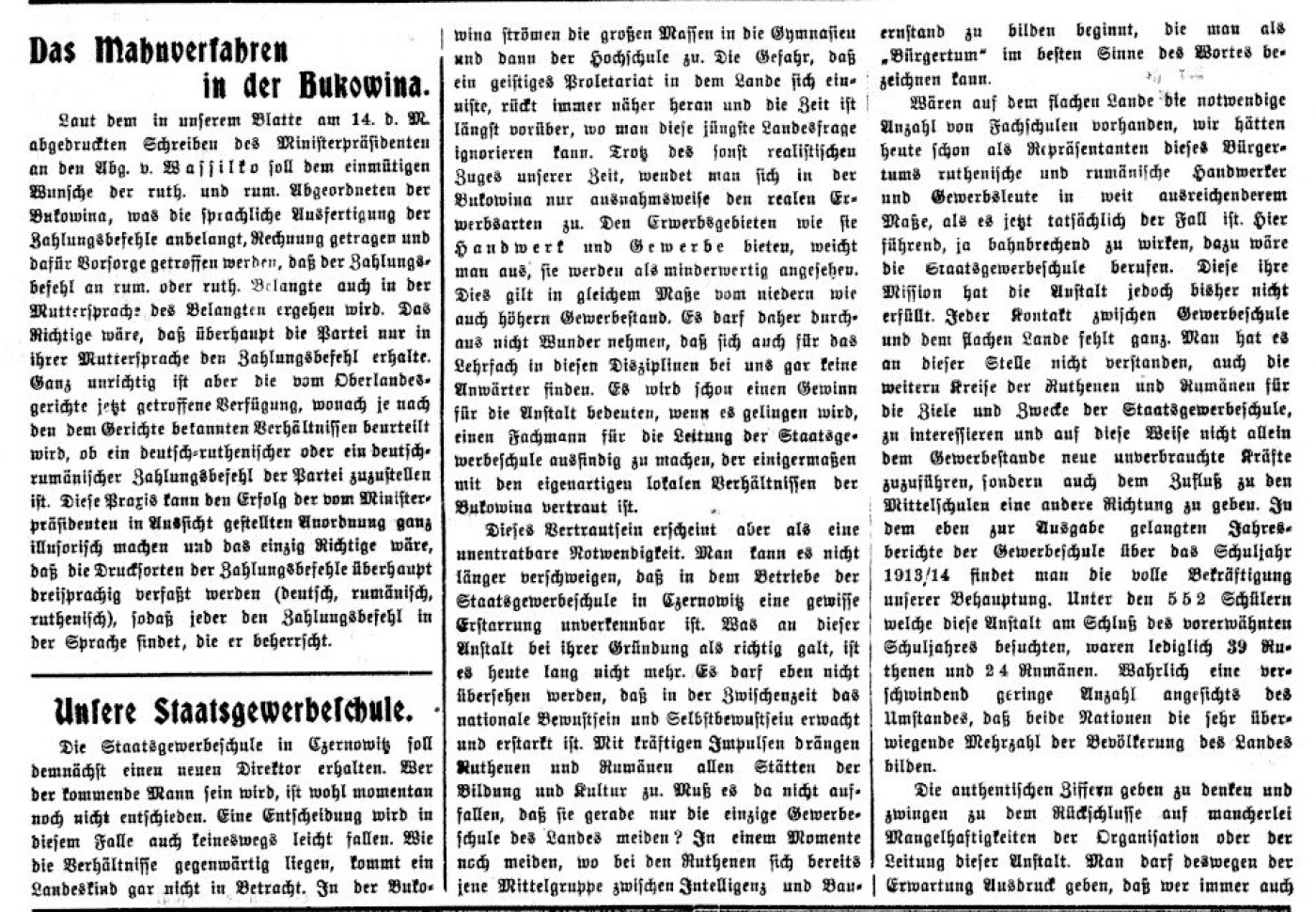
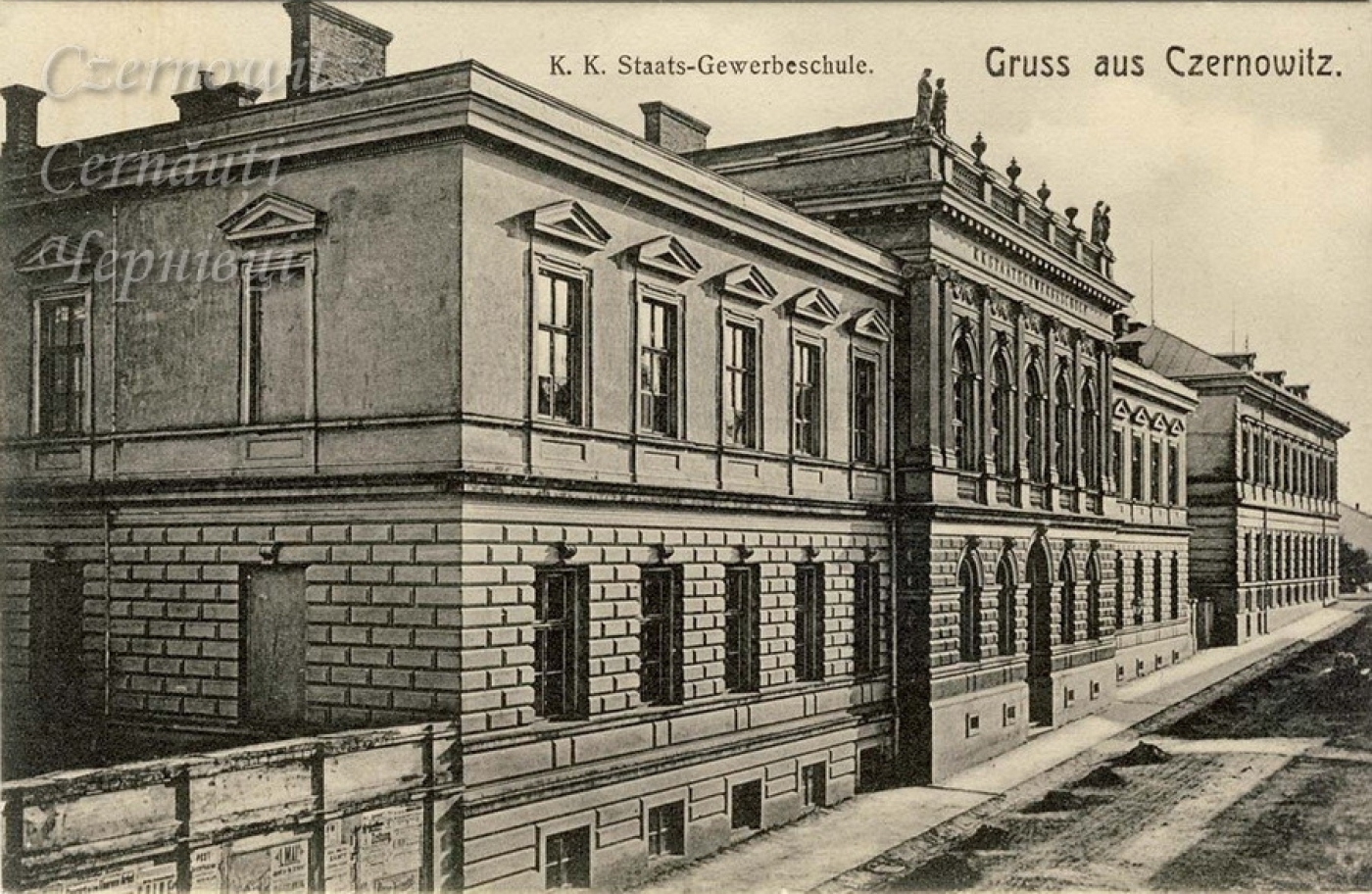
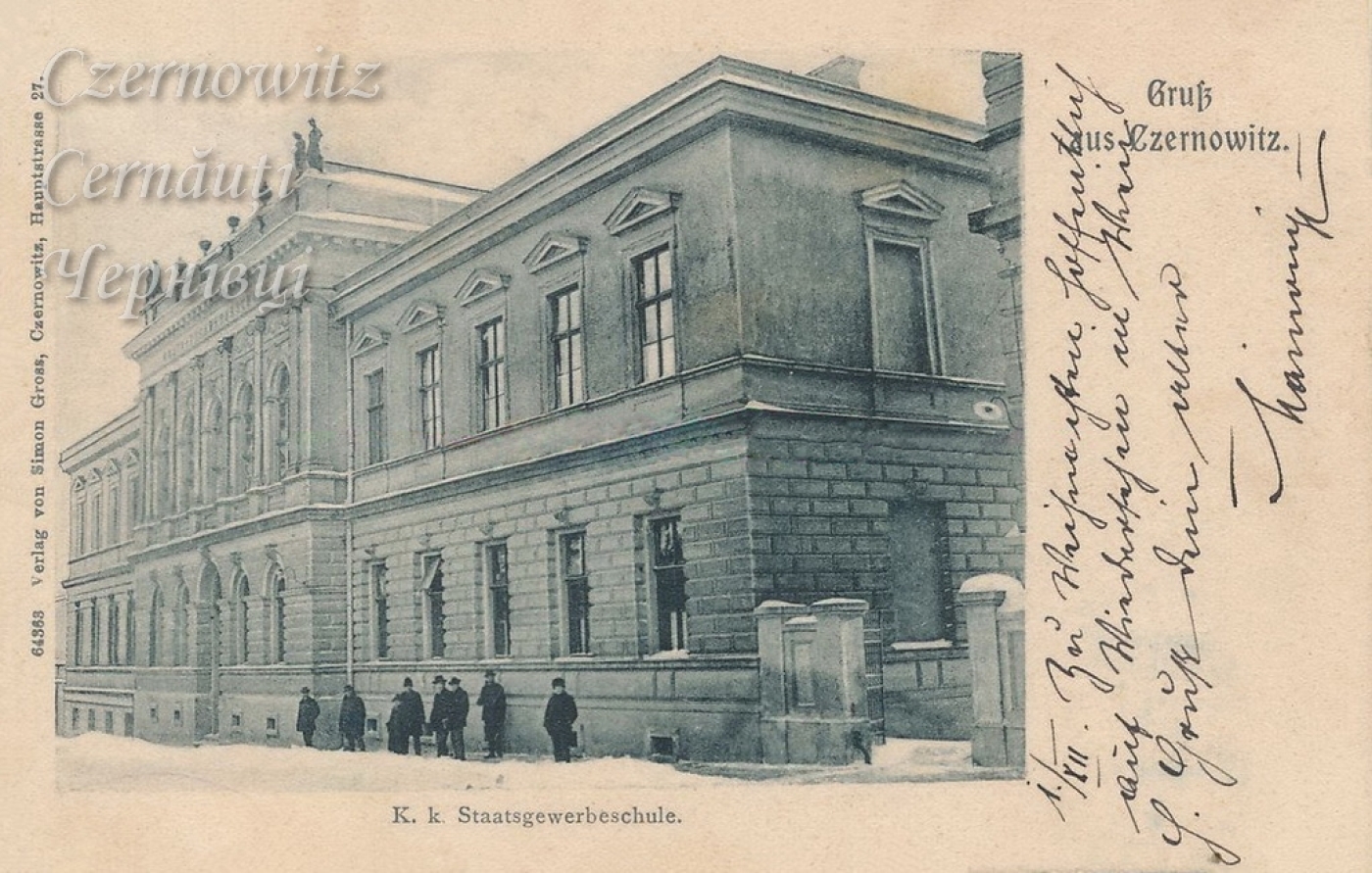
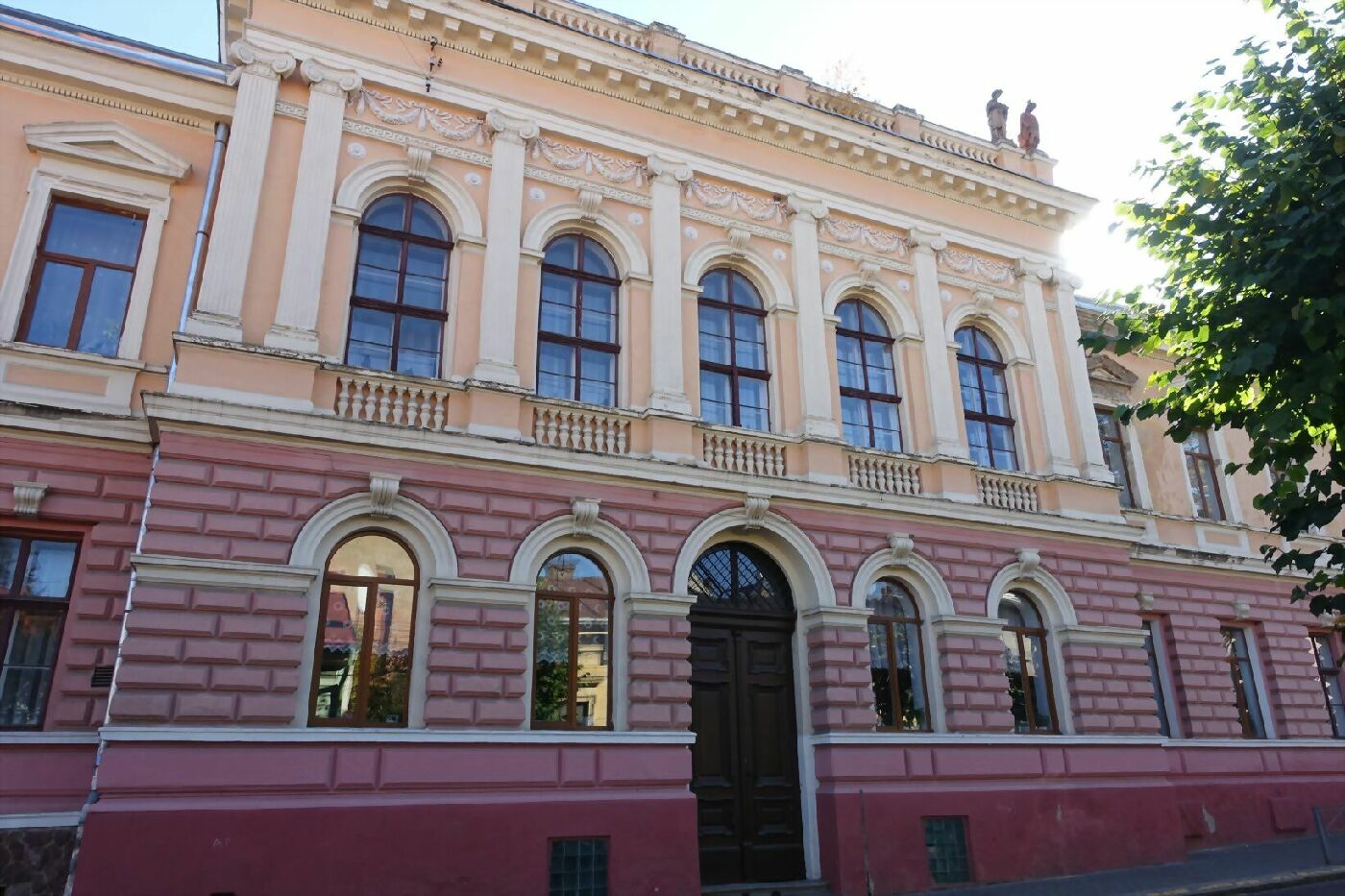
Instruction at the trade school was exclusively in German, which meant that the vast majority of students were German and Jewish. Between 1876 and 1914, 1,734 students graduated from the State Trade School (including 1,078 from the commercial school, 576 from the foreman's school and 80 from the special school for building and furniture carpentry). 1,225 (70.6%) of the graduates were Jews, 261 (15.1%) Germans, 123 (7.1%) Poles, 65 (3.7%) Ruthenians, 49 (2.8%) Romanians and 11 belonged to other ethnic groups (Procopovici, pp. 131-134). From the turn of the century, the industrial and commercial schools, which were usually held in the evenings or after school hours, were popular as practical training centres. These courses were attended by young students as well as workers, merchants and craftsmen who wished to broaden their theoretical and practical knowledge. In the last years before the First World War, these schools were established in all the towns and villages of Bukovina. The number of students grew steadily and by 1910 there were more than 1,000. As the language of instruction in these schools was almost exclusively German, only a few Romanians and Ukrainians attended. In the school year 1912/13, 1,535 pupils were taught in the twelve secondary schools in Bukovina. According to their mother tongue, 1,093 were German-speaking, 163 Romanian-speaking, 153 Polish-speaking and 118 Ukrainian-speaking (Österreichische Statistik, vol. 14.3, p. 290f.).
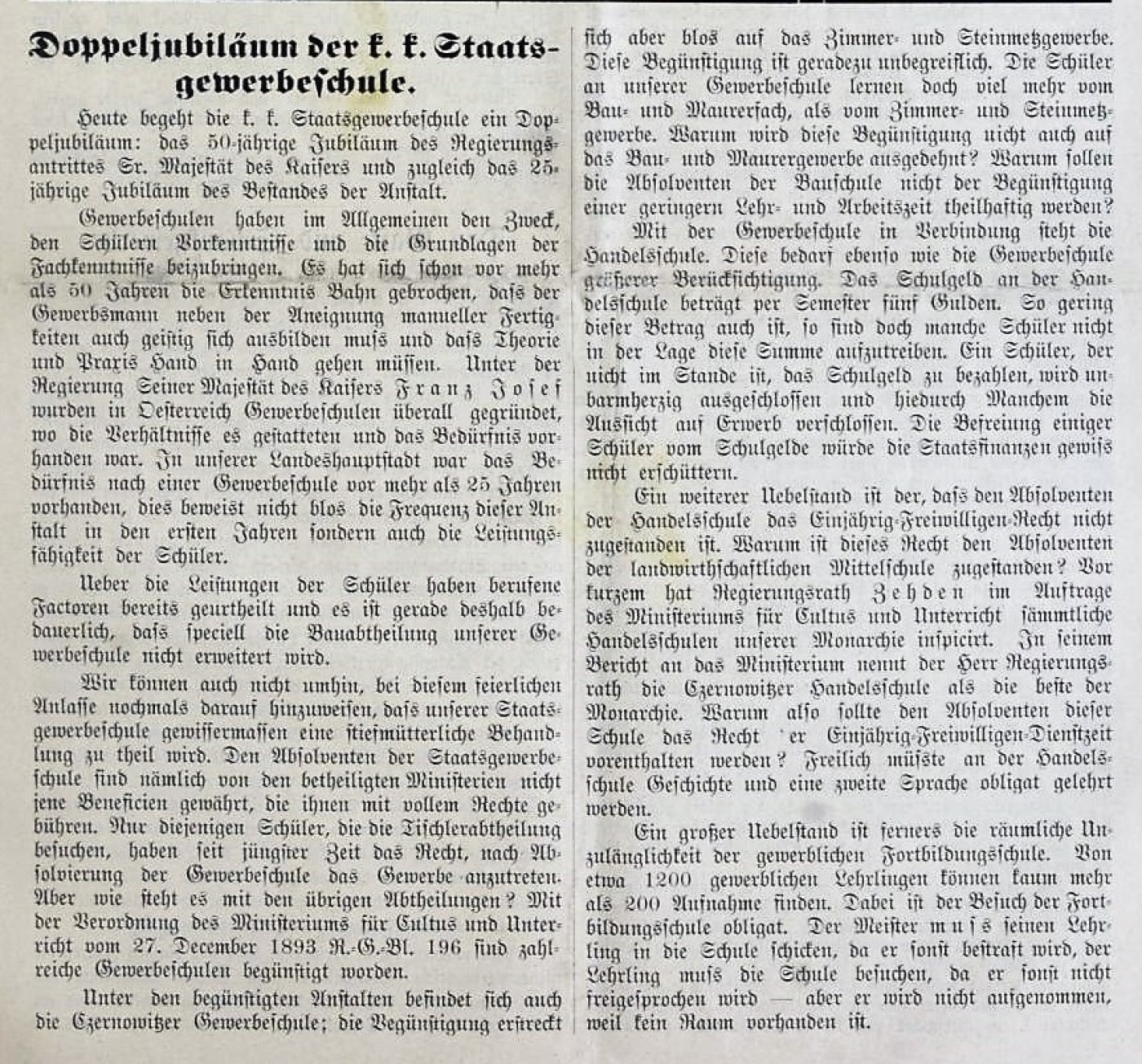
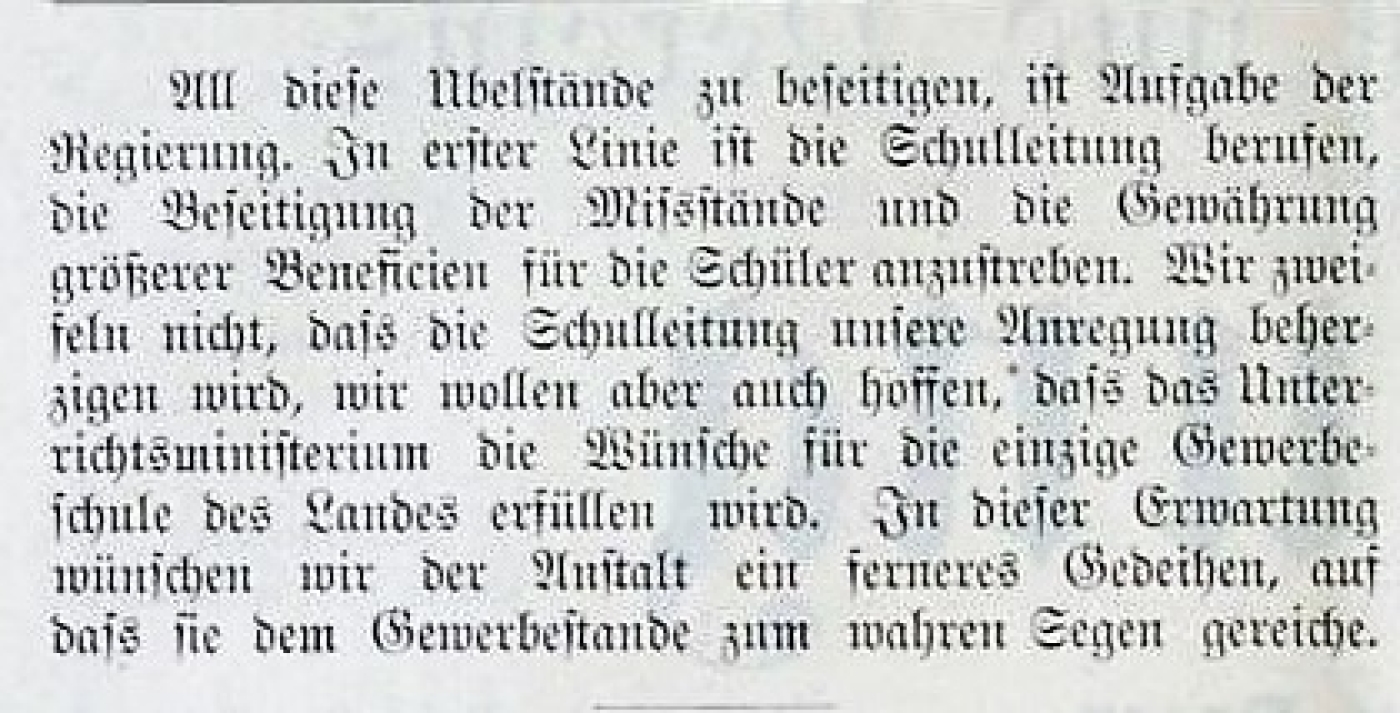
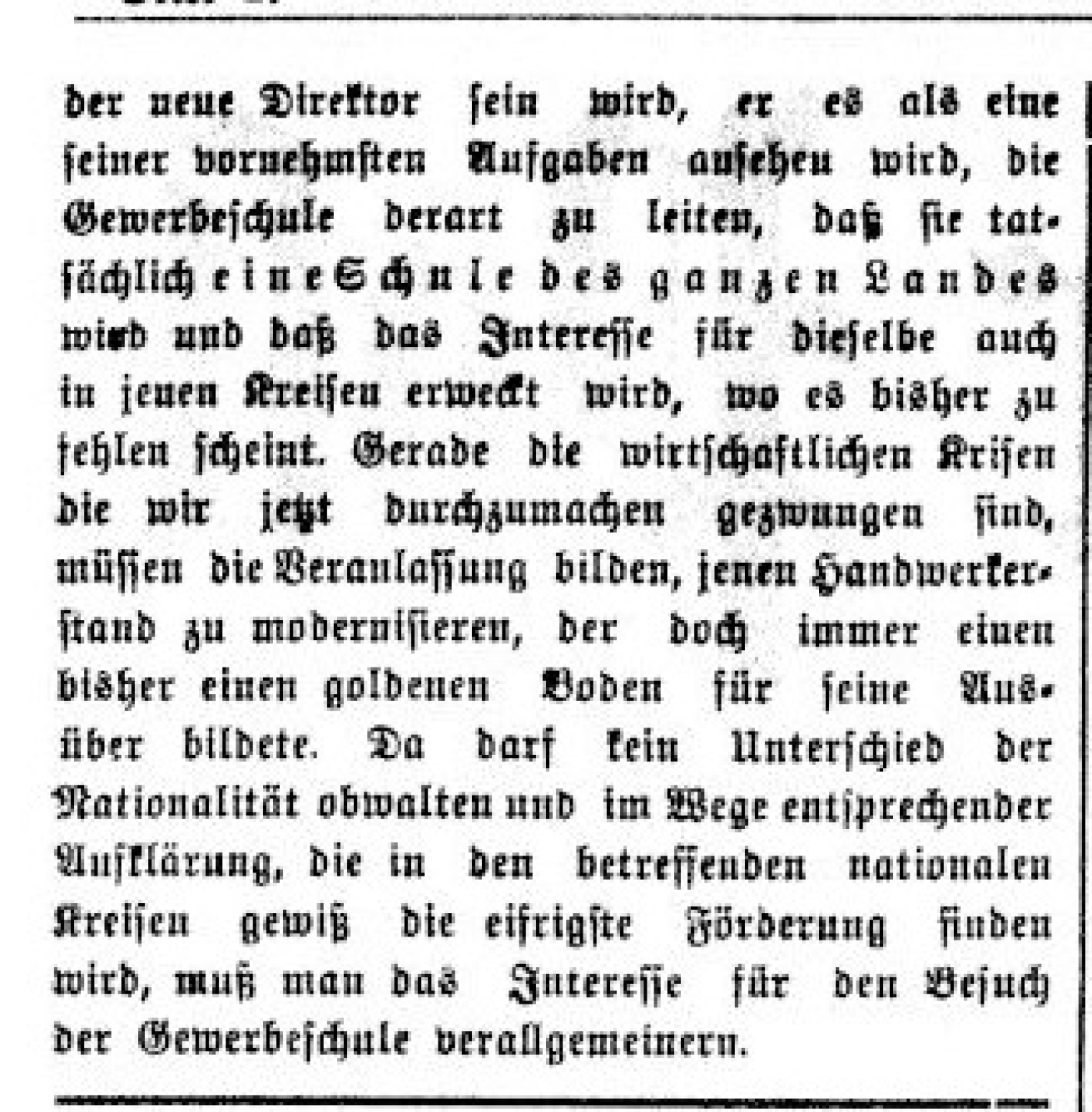
The local press criticised the fact that, for capacity reasons, only a small proportion of the city's commercial apprentices could be admitted to the commercial further education college - part of the trade school - and called on the Ministry of Education to take countermeasures. In 1898, for example, only 200 out of 1,200 industrial apprentices were able to attend this school (Genossenschaft, 14 August 1898, p. 1).
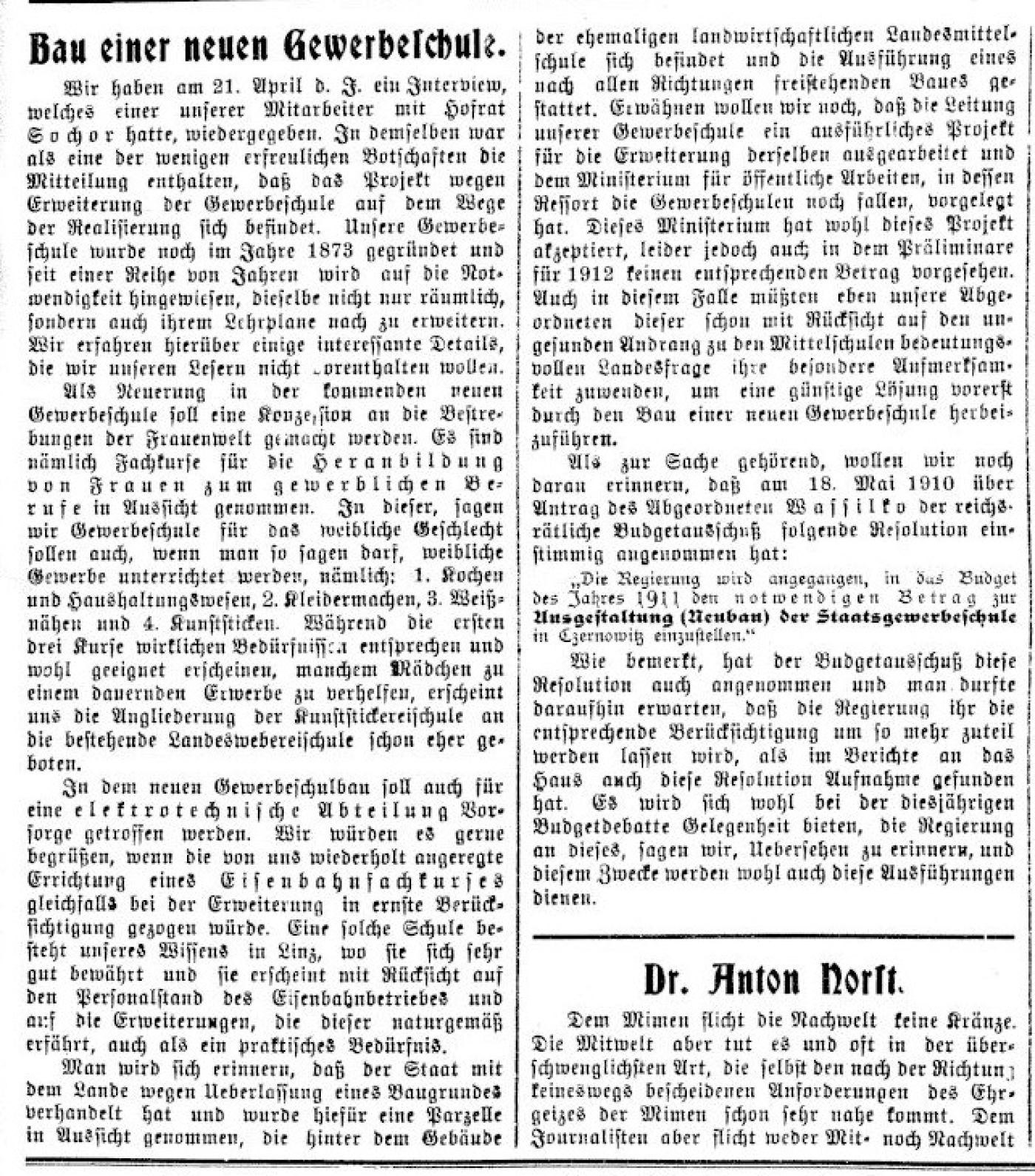
For this reason, until the outbreak of the First World War, the authorities and the press regularly discussed the expansion of the institution and the construction of a new building, which was finally decided upon but could not be realised.
Text: Constantin Ungureanu und Markus Winkler
Sources:
- Traian Procopovici: Şcoala de Conductori de Lucrări Publice, Cernăuţi 1873–1923. Istoricul scris cu jubileul ei de 50 ani [Schule für Leiter im öffentlichen Dienst, Czernowitz 1873–1923. Historischer Abriss anlässlich des 50-jährigen Jubiläums].Cernăuţi 1924, S. 131-134.
- K.K. Statistische Zentralkommission (Hg.): Österreichische Statistik, Neue Folge. Bd. 14.3: Statistik der Unterrichtsanstalten in Österreich für das Jahr 1912/1913. Wien 1917
- Constantin Ungureanu: Mittelschulen und höhere Lehranstalten in der Bukowina vor 1918: Nationen, Sprachen und Geschlechter. Ein statistischer Überblick. In: Markus Winkler (Hg.): Partizipation und Exklusion. Zur Habsburger Prägung von Sprache und Bildung in der Bukowina. 1848 – 1918 – 1940, S. 115-128