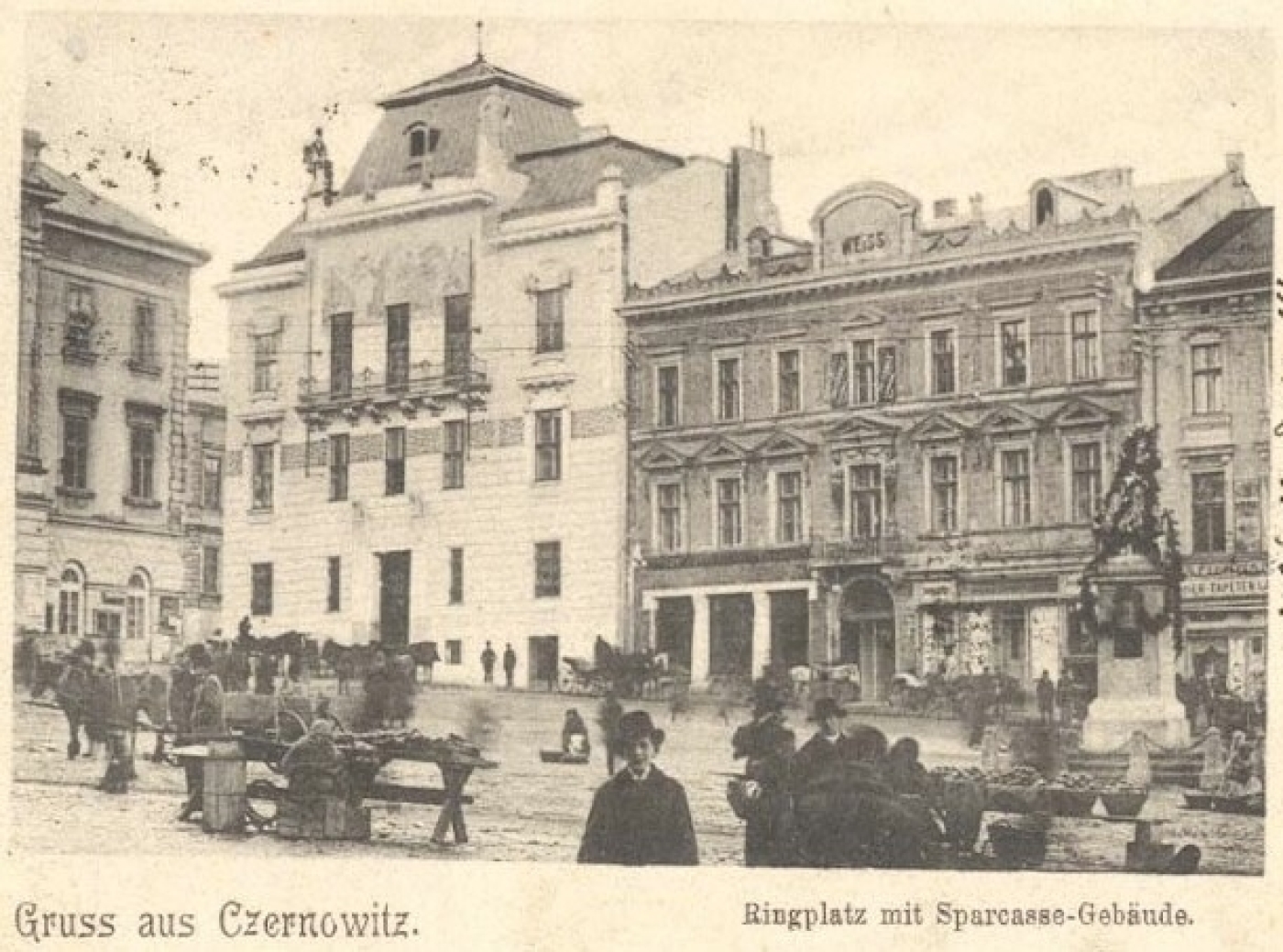
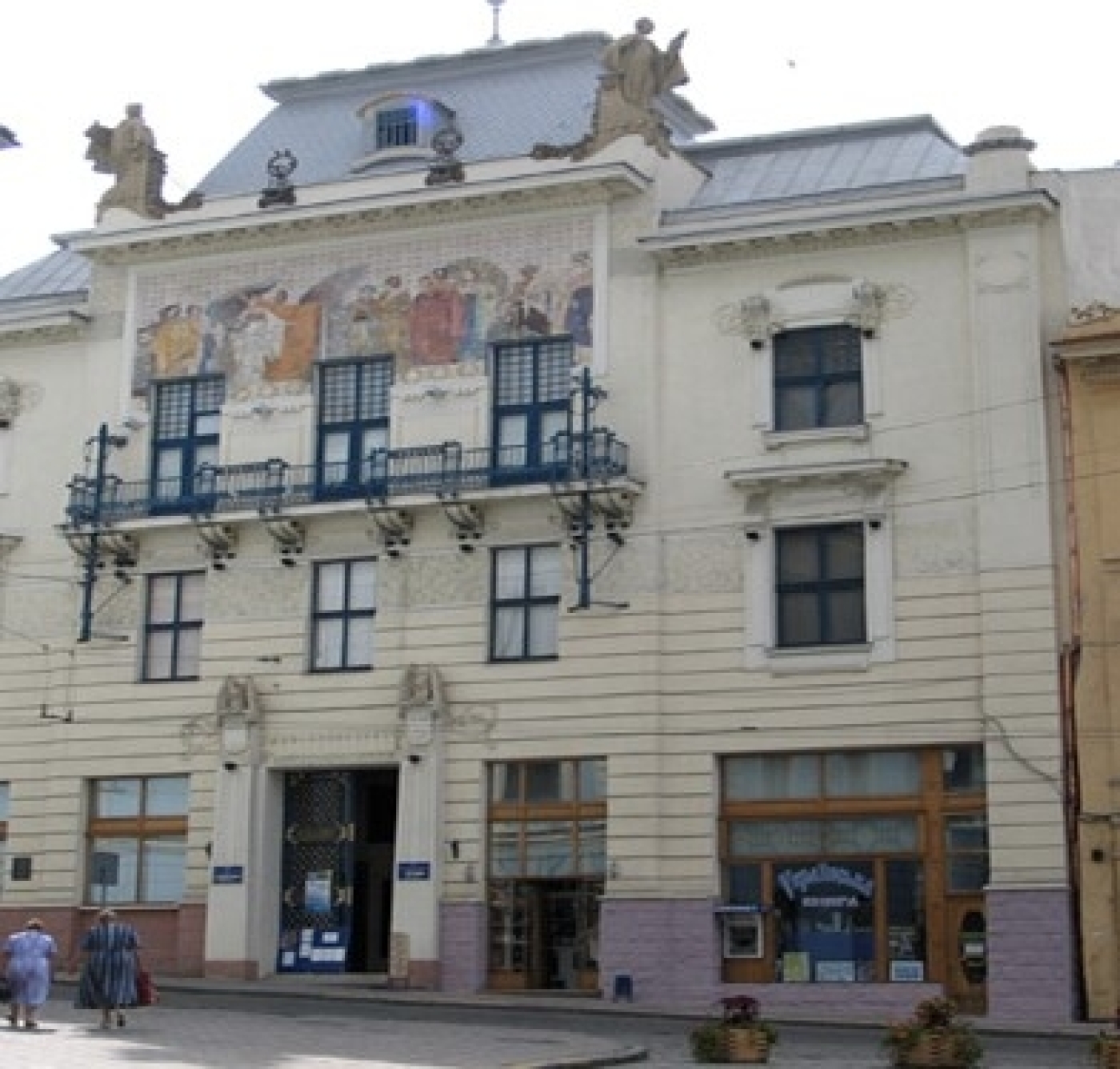
The former Savings Bank building was named “Chernivtsi Olympus” by the locals. The reason for this is the huge mosaic on the front facade, depicting twelve ancient deities. It was created in 1904 by the Austrian painter Josef Adolf Lang using ceramic tiles from the Hungarian Zsolnay factory. The allegorical depiction represents the incorporation of Bukovina into the Habsburg Empire, with the twelve gods symbolising the provinces of Cisleithania, the territory of the Austro-Hungarian Empire, which included all the crown lands ruled by the Austrian Crown. Zeus, representing Upper Austria, draws the observer's attention to himself with his two large wings. He holds a sword and an oak wreath as symbols of victory. Hera, representing the Habsburg capital Vienna, wears the Bukovina coat of arms with the head of an aurochs on her clothing, emphasising that Bukovina, represented here as a young man in a goatskin, is now part of the Monarchy.
In addition to the mosaic, the external design of the building is characterised by clear symmetry. Two eagles, representing the Habsburg Empire, frame the double-winged entrance. It is decorated with floral motifs and horizontal bees. The two statues on the roof represent Demeter, the goddess of fertility, and Klotho, the prophetess of fate. Finely stylised floral and foliate ornamentation decorates the exterior and balcony balustrades. The interior of the renovated Art Nouveau building is no less impressive. It features an original spacious staircase and vestibule, a Viennese Baroque stucco ceiling attributed to the Bukovina-born artist Mykola Iwasjuk, and classical columns that emphasise the stability of the building. The staircase on the first floor is decorated with busts of the Roman gods Mercury and Minerva. Stained glass windows in the Art Nouveau style - one of which depicts the former Bukovina coat of arms - complete the architectural work of art.
Since its foundation in 1988, the Chernivtsi Art Museum has been housed in the former Savings Bank building. The three-storey collection is one of the largest and most important art institutions in Bukovina. Some 10,000 paintings, photographs and graphics by regional and national artists, as well as traditional Ukrainian costumes, handicrafts and jewellery from the 17th to the 20th centuries, are displayed in permanent and temporary exhibitions. One of the centrepieces is a collection of more than 3,000 Bukovinian and Hutsul Easter eggs. Most of the artworks were donated by the Ethnographic Museum in Chernivtsi. Works found during research trips and art expeditions, as well as donations from artists and patrons, complete the collection, which has almost doubled in size since its inception. In addition to the art museum, the building houses a book and souvenir shop and a tourist information centre. There is also a café serving Viennese cakes and coffee.
Text: Daniela Gast