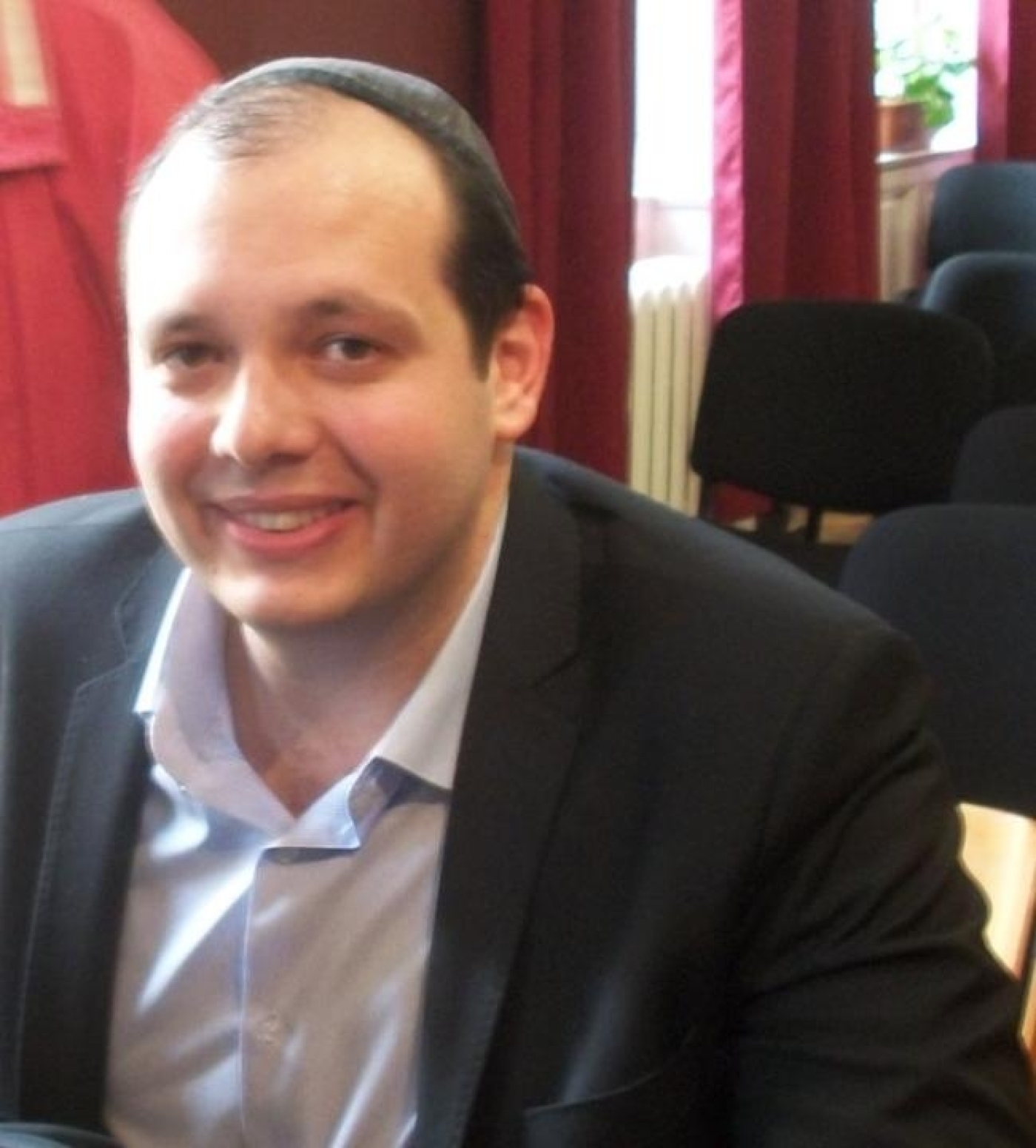
Question: We are meeting here in the former Jewish National House. What can you tell us about the building?
Milman: We are in a very interesting situation because the former Jewish House is now the central 'cultural palace' of Chernivtsi. The Jewish community uses only two rooms here. There is also a Jewish Museum on the ground floor of the building. The rest of the building is used for concerts and entertainment programmes for the residents - it is a cultural meeting place for everyone, not just Jews.
Is there any cooperation with the (other) national houses in the city?
Yes, of course. With the German House, for example. Chernivtsi is not that big, so we all know each other and visit each other from time to time.
What other places in Chernivtsi are used by the Jewish community today?
Various other buildings belong to the Jewish community, such as the two synagogues. The Jewish community is based on our religion and our synagogues. One of the synagogues is very old and was used even during the war. This is very special because in the 1940s there were only 14 synagogues open in the whole of Europe.
What cultural events does the Jewish community organise and where do they take place?
Where events are held depends entirely on the nature and size of the event. Small events, such as a concert, can be held here in the building, but if we want to accommodate 400 people, for example, we use a large restaurant. Large Jewish festivals such as Hanukkah are traditionally held in large squares such as the Theatre Square. Musicians play and sometimes the mayor gives a speech. Most activities are open to everyone. Some events are also attended by tourists, including Jewish tourists, who like to visit Chernivtsi because it is a very spiritual city for them.
What is the current size of the Jewish community in Chernivtsi and the region?
Interesting question! There is no clear answer because there are different ways of counting the members. If you look at the numbers according to religious law, there are no more than 2,000 people. If you calculate according to Israeli law, there are about 10,000, most of whom live in Chernivtsi itself.
What is the composition of this Jewish community?
The Jewish community is very diverse. Today there are many people who move away from Ukraine. There are also people living here who didn't know about their Jewish roots for a long time. As soon as they find out, they often come to us in the community - an interesting process. The Jewish community is voluntary. In addition to myself, there are currently about 20 to 30 members who are particularly motivated and interested, and who drive the work in the community forward.
How do you think the role of the Jewish community has changed over the years?
You know, the Jewish community has one main goal: to unite all Jews. This goal has not changed, but the way in which it is achieved has, of course, changed - just as the whole world is changing.
How are Jewish traditions maintained in Chernivtsi?
For example, there is a communal Jewish school where Hebrew, Jewish traditions and history are taught. This school is not only attended by Jews. It is not a religious Jewish school, so all children who want to or who have distant Jewish roots can go there. People who want to delve deeper into Jewish tradition can pursue their interest, for example, in the synagogue. Rabbis offer classes there. Hebrew language courses are also available through Israeli organisations. Yiddish is not so widespread, but there are older people in the community who like to teach it privately.
Many young people now leave Chernivtsi to study in other cities or abroad. Why did you choose to stay here?
Well, on the one hand I'm not that young. On the other hand, I was born here, my family is from here, I went to school here - I love the city. And there's a lot for me to do here.
So you are not entirely happy with the current situation of the Jewish community?
No, because we need more Jewish people to get involved in the community. We also need more money to organise the various events. There are many wishes...
The fact that young people in particular are leaving the community is also evident in your community. What are you doing to attract them?
Since we are a community that is not open to everyone, but explicitly to Jews and people with Jewish roots, we don't advertise in the strict sense. We offer the younger generation many different activities, such as workshops, and communicate with them through Facebook, Instagram, ... the best way to reach young people is through social media.
How has the city changed in general during the time you have lived here?
According to official statistics from the State of Israel, about 90,000 people from Chernivtsi and the region have emigrated to Israel in recent decades. Between 20,000 and 30,000 have emigrated to countries such as Germany and the USA. There has also been national migration to larger cities such as Kiev and Lviv. Ultimately, however, the population has remained more or less the same. This means that different people live here now, and this has also brought about changes: culturally, it is a different city now than it was when I was a child 25 years ago.
Thank you, Mr Milman.
Chernivtsi, 11 May 2017
The interview was conducted by Daniela Gast, Lilian Wascher and Alona Prozorova.
Photo: Chernivtsi Museum of Jewish History and Culture of Bukovina