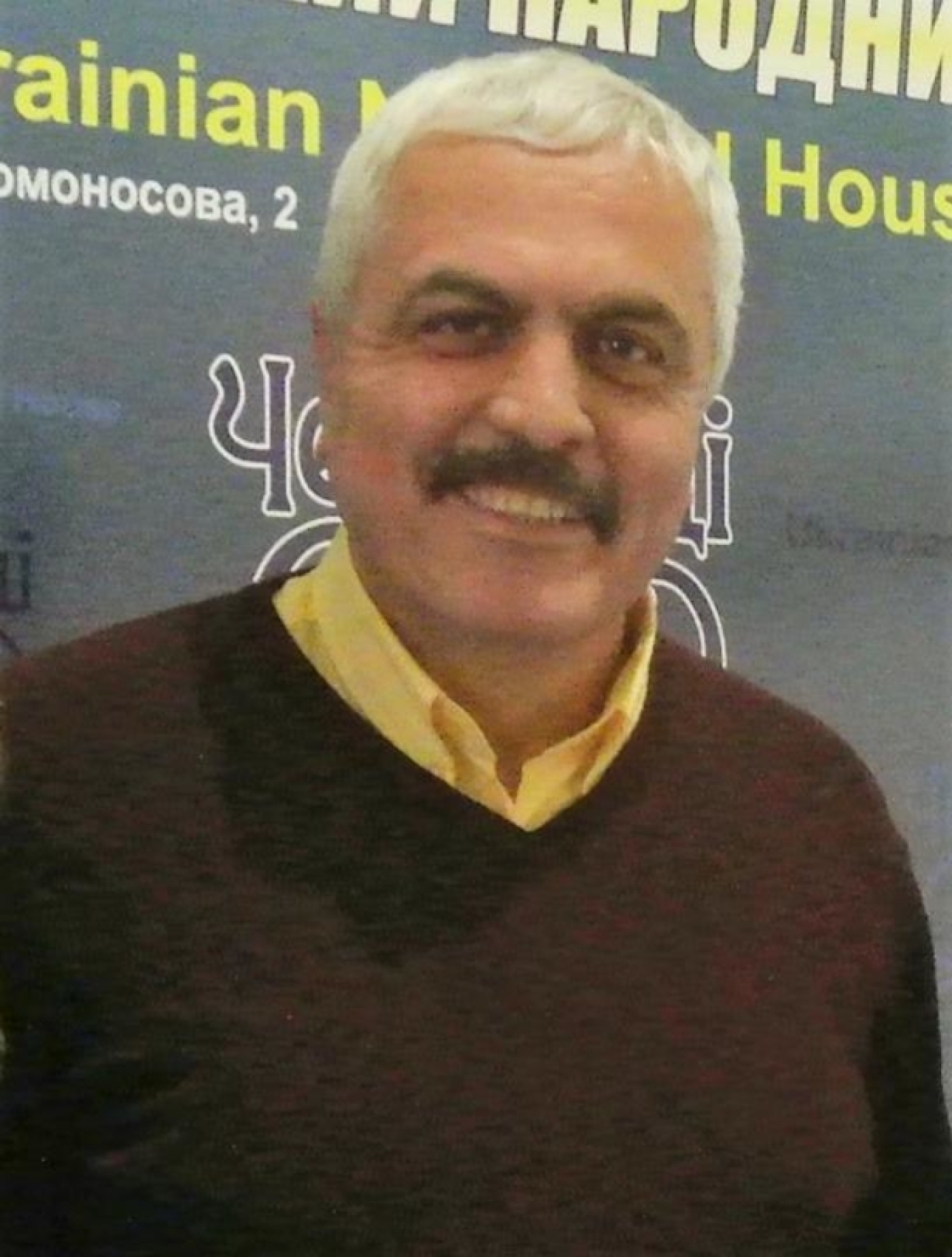
Volodymyr Staryk welcomes us in the anteroom of his office in the National House. The building is large, extending over two floors, with some small offices, but also a large meeting room. As we leave the director's office, which is enclosed like a small museum, we enter an exhibition that corresponds to the director's area of interest. The conversation becomes a linguistic potpourri, a mixture of Ukrainian, English and German. When our interviewee is in the middle of his story and seems to be trying to make his point, the translation into Ukrainian is sometimes too slow for him - so he switches to English, with a sprinkling of German, before switching back to Ukrainian, which is perhaps more suited to his fast-paced way of speaking.
The Ukrainian House receives almost no funding from the state, Staryk complains - unlike the other national houses in the city. The running costs, especially heating, cost a lot of money. They are able to pay for this through income from the organisations that rent rooms in the house. They also receive funding for their own projects. The Ukrainian House's public projects include a children's parliament and an election observation and monitoring project. The house is political and cultural, and attempts are made to preserve its Ukrainian character, even if the nationalities of those involved are not considered, as Staryk points out. Although the statutes state that all events must be held in Ukrainian, it is clear that eastern Ukrainians also speak Russian here. 15 organisations are currently active and using the building's infrastructure. Of course, we are particularly interested in the current situation: Has the role of the National House or its audience changed since the Maidan? No, according to the director, the house has the same role today as when it was founded in 1884. He does, however, hope that local politics will now be more supportive, but: "What we did before Maidan, we are doing after Maidan.”
The Ukrainian language and the preservation of the Ukrainian language is an element that runs through various periods: During the Habsburg monarchy, says Staryk, the National House took on a special significance. There was no Ukrainian school, so the Ukrainian House became a meeting place to teach the language and to preserve and pass on Ukrainian culture and music. During the period of Romanian rule, it was forbidden to learn the Ukrainian language. Courses for the illiterate were held in the National House, and reading and writing were taught and learnt privately - even if they were persecuted by the Romanian rulers. And today? “We are a national minority in Chernivtsi," says Staryk. Yes, he agrees, the house is a people's house for the people of Chernivtsi - but the Ukrainian identity must be preserved at all costs. Staryk has written a book, more of a pamphlet, telling the story of the different groups and their national houses. The book should unite everyone, he says of his ideal, but everyone reads only their own part. The nationalities live together, but then separate from each other. There is only ceremonial cooperation between the national houses. The book also symbolises his desire for change, for the need to engage with the different nationalities. At the same time, he believes there is too much "worship to the West", too many memorial plaques dedicated to non-Ukrainian personalities and too few to Ukrainian ones.
Volodymyr Staryk is a man of convictions, as the interview makes clear. Yes, he is in favour of the coexistence of national groups - but his main concern is to strengthen the Ukrainian language, which he personally feels is underrepresented in the city, be it in the town hall or in the cityscape. For us, the Ukrainian language is very present on our forays into Chernivtsi: we see the blue and yellow in the flags, on the painted facades of the houses or in the painted cars. We see Taras Ševčenko as a representative of a Ukrainian culture of remembrance in the central squares of towns and villages. But we are only visiting this city. Volodymyr Staryk comes across as a man who has spent the last three decades standing up for his beliefs. Like someone who could now be described as resigned. We ask him: How do you imagine the perfect Chernivtsi? ‘I am too old to dream.’
For Staryk, the myth of Bukovina, which in a way brought us to Chernivtsi, also stands for a lack of recognition of the Ukrainian. People identify more and more with their regions - they are from Odessa, Donbass or Bukovina, not from Ukraine. He paints a picture of a city that, for us, stands for cultural diversity and openness, which he also emphasises - but whose emphasis, for him, seems to push the Ukrainian in the Ukrainian region into the background. After the interview, we both agree that it was a very interesting and intensive discussion. We gained an insight into the ambivalent relationship between a committed man and his city. And also, that after the interview we had even more questions than before. What does it mean for a place when a culture of remembrance is brought in or brought back from outside, for example through initiatives from Western countries, which can be seen as significant for the place itself, but at the same time overlays others? Chernivtsi is a place full of memories - the conversation with Volodymyr Staryk brought us a little closer to his memories and those of the Ukrainian National House. We are grateful for his time and the interview.
The interview with Volodymyr Staryk was conducted by Kirsten Heyerhoff and Marit Haferkamp on 11 May 2017. Iryna Virstiuk simultaneously translated the Ukrainian parts into German.
Photo: Kirsten Heyerhoff und Marit Haferkamp
Literature:
- Mariana Hausleitner: Fünf verschiedene Vereinshäuser in Czernowitz und ihre Entwicklung in bis 1914. In: Peter Halsing, Heidi Hein-Kircher, und Rudolf Jaworski (Hg.): Heimstätten der Nation. Ostmitteleuropäische Vereins- und Gesellschaftshäuser im transnationalen Vergleich. Marburg 2013 (Tagungen zur Ostmitteleuropa-Forschung, 32), S. 89-112.