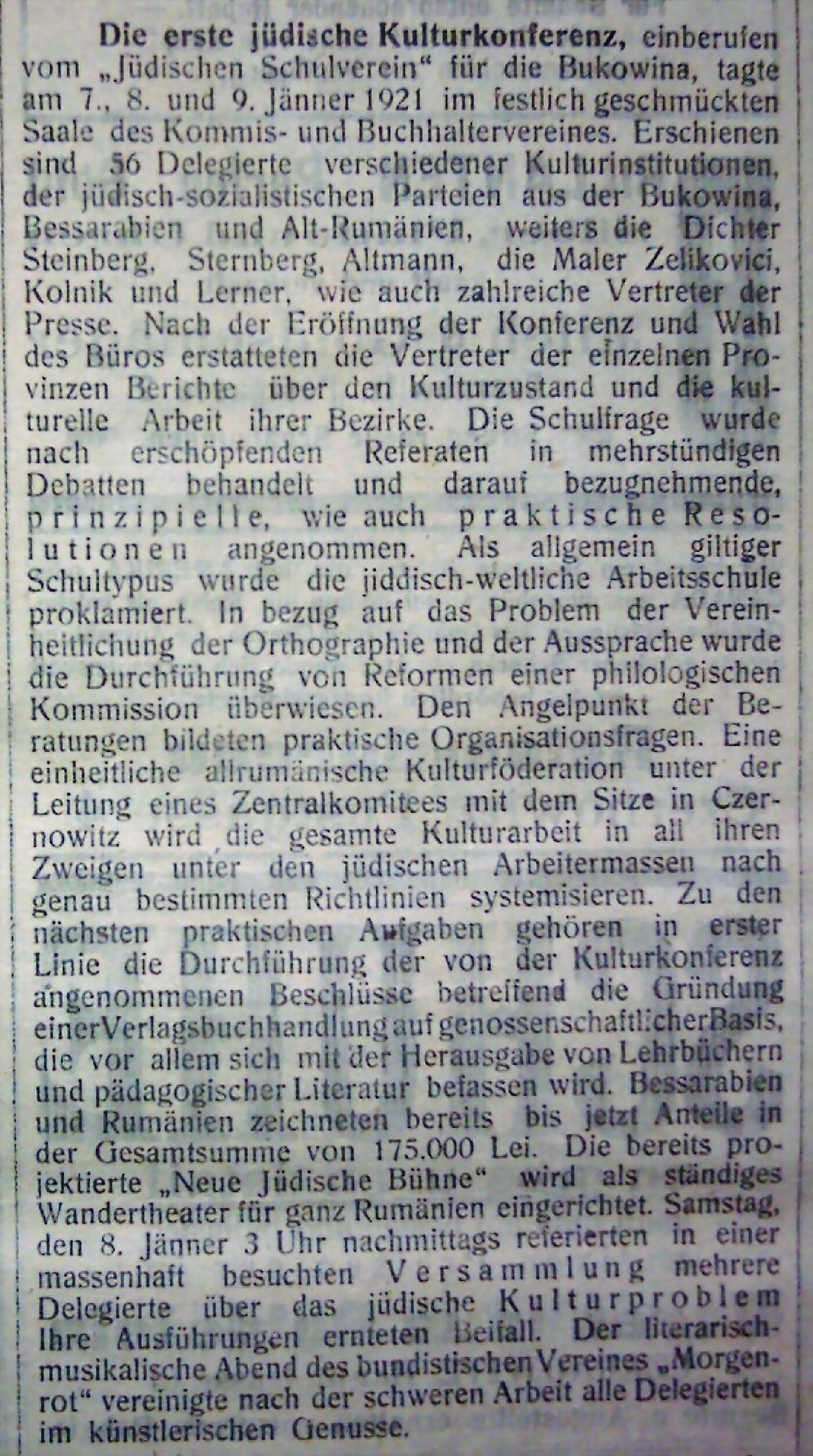
The programme's aim of spreading Yiddish in schools proved difficult. The Association applied to the Romanian Ministry of Education for the establishment of a private Jewish primary school and a Jewish gymnasium, but both were rejected. Between 1919 and 1923, however, Sunday classes were organised for Jewish primary and secondary school pupils to learn Yiddish. However, the initial enrolment of 850 dropped to 450 in the fourth year, and the classes were discontinued. From 1921, the Yiddish School Association organised an annual Jewish cultural conference. At the first cultural conference, held in Chernivtsi from 7 to 9 January 1921, 56 delegates from various cultural institutions of the Jewish socialist parties from Bukovina, Bessarabia and old Romania met with the poets and artists Elieser Steinbarg, Jakob Sternberg, Mosche Altmann and Arthur Kolnik (Vorwärts, 13 January 1921, p. 3). The focus of the conference was the question of schools. A resolution proclaimed the “Yiddish secular work school” as the general form of school. A philological commission was to initiate future reforms to standardise the orthography and pronunciation of Yiddish. The prospect of Yiddish being recognised as a language of instruction, or at least as a subject, encouraged the activities of the association.
A cultural association based in Chernivtsi was to coordinate Jewish cultural work throughout the country, and the establishment of the association's own publishing house Kultur was planned for the publication of textbooks, educational literature and children's books. The Jiddische Verlagsgesellschaft Kultur was registered as a limited liability cooperative in Chernivtsi on 24 June 1921. Its president was Joseph Kissmann. The aim of the society was the publication and distribution of periodicals and writings by members. Announcements were published in the Yiddish newspapers Frayhayt (Poale-Zionist) and Dos naye lebn (Bundist) (Czernowitz State Regional Archive, F. 118, 3, 1252, p. 14). The first publication of Kultur was a children's primer with Yiddish texts by Steinbarg and illustrations by Kolnik. From 1921, Israel Schäfler edited the monthly magazine Kultur for the Yiddish School Association, which included Yiddish fiction, poetry, literary criticism and educational writings. The association had a library, which became “one of the most important and largest Jewish libraries in the country” after taking over several other smaller libraries, such as the Jewish Public Library of the academic organisation Jüdische Kultur.
The Yiddish School Association was also active in the theatre and wanted to modernise the Jewish theatre that had been operating in Chernivtsi. As early as 1919, the association organised theatre performances under the title “Dramatic Evening”. On 19 November 1919, actors from the Axelrad ensemble performed several small plays at such an event. In 1920, the Yiddish School Association decided to create a Jewish art theatre, the New Jewish Stage, under the direction of the Yiddish poet and journalist Jakob Sternberg, as a counterpart to Abraham Axelrad's Jewish theatre in Chernivtsi and as a “permanent travelling theatre for the whole of Romania” (Vorwärts, 13 January 1921, p. 3). Elieser Steinbarg, Mosche Altmann and Sternberg took over the dramaturgical work. A two-month programme was drawn up, with 24 performances in Chernivtsi and a subsequent tour of Romania (Czernowitzer Morgenblatt, 5 January 1921, p. 3). The development of Jewish art theatre in Chernivtsi is not documented. The Czernowitzer Allgemeine Zeitung reported that Sternberg was planning to establish “a modern Jewish stage for exclusively serious artistic dramas, comedies and musicals” (Czernowitzer Allgemeine Zeitung, 21 November 1920, p. 4) and to teach actors Jewish language and literature in special theatre courses. Other theatre activities of the Yiddish School Association included matinees on the Yiddish language and drama, and evenings of lectures on Jewish theatre. On 20 May 1922 a matinee was held to commemorate the sixth anniversary of Scholem Alejchem's death (Czernowitzer Morgenblatt, 19 May 1922, p. 2); on 16 December 1922 Steinbarg gave a lecture on Schalom An-Ski's Dibbuk and read from his own poems (Czernowitzer Allgemeine Zeitung, 14 December 1922, p. 3). During the Wilna troupe's stay in the autumn of 1923, the Yiddish School Association organised a matinee with actors from the troupe in the Jewish Toynbee Hall (Czernowitzer Morgenblatt, 25 October 1923, p. 3). In 1924 the association had 623 members (Soifer, p. 98). At the beginning of the 1920s the association was based in the Jewish National House.
Text: Markus Winkler
Materials:
- Arthur Kolnik: "Der jüdische Schulverein" in Czernowitz. In: Jüdisches Städtebild Czernowitz. Hrs. V. Andrei Corbea-Hoisie. Frankfurt/M. 1998, S. 181-188.
- S.A. Soifer: Das jüdische Wohlfahrtswesen in Czernowitz. Cernăuţi 1925.
- Markus Winkler: Jüdische Identitäten im kommunikativen Raum. Presse, Sprache und Theater in Czernowitz bis 1923. Bremen 2007 (hier: S. 174f., S. 221-223)