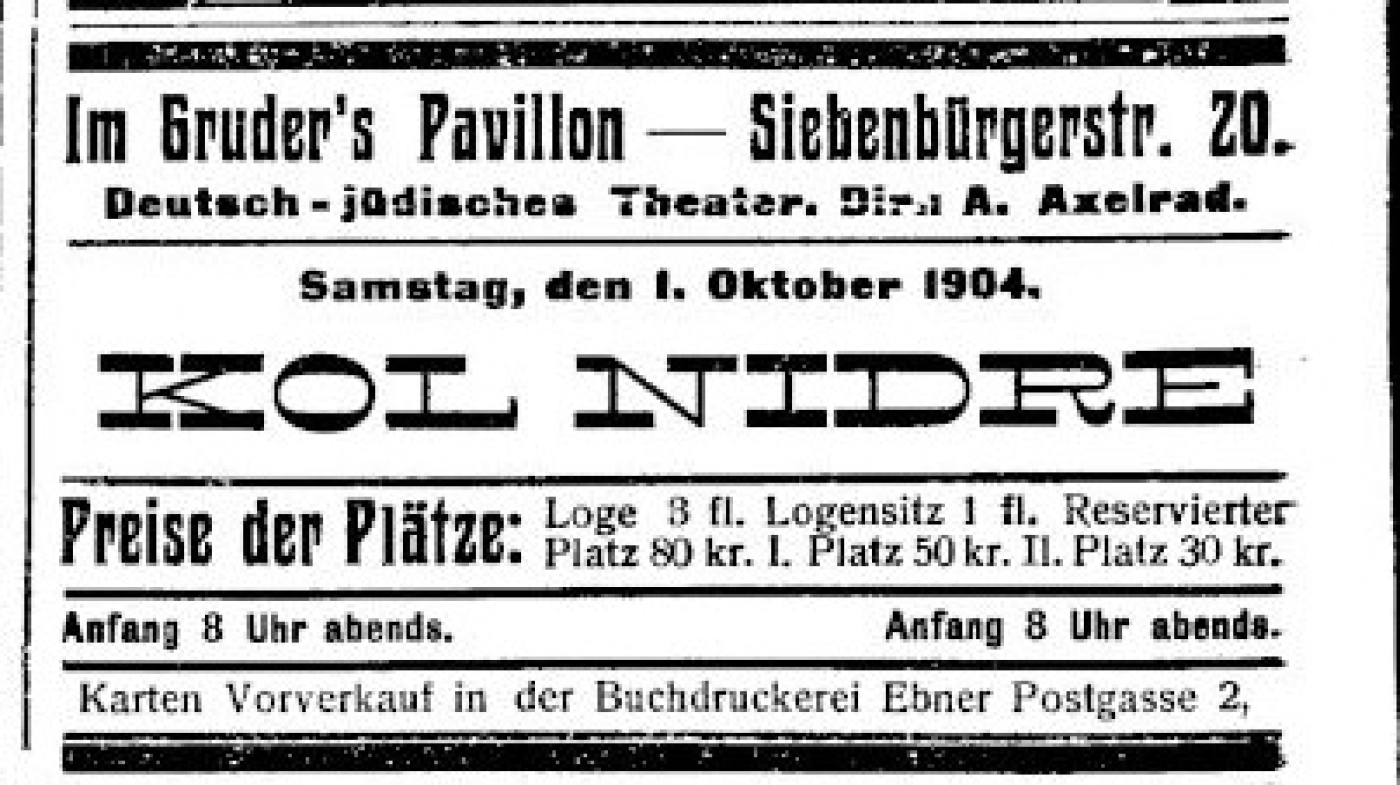
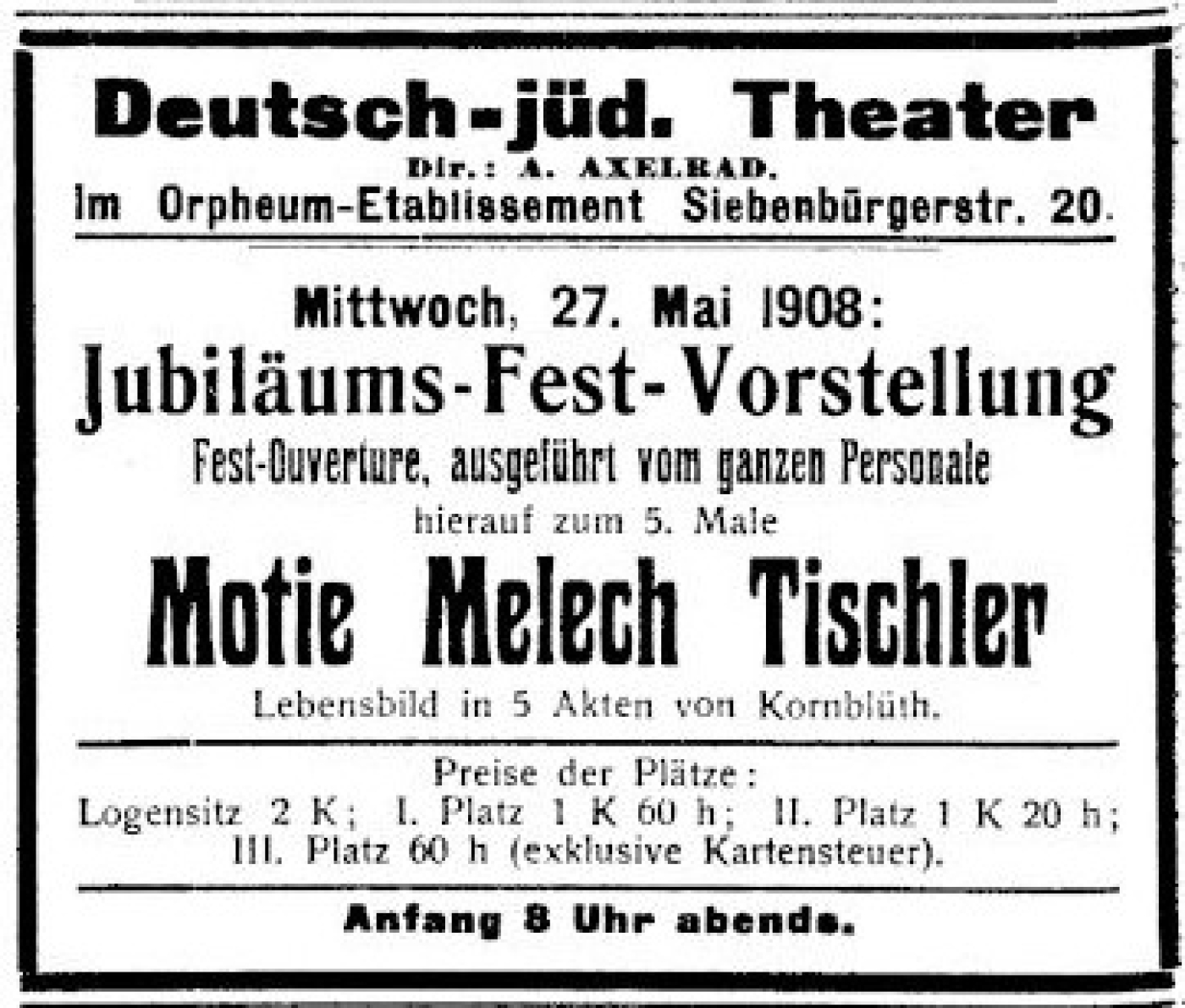
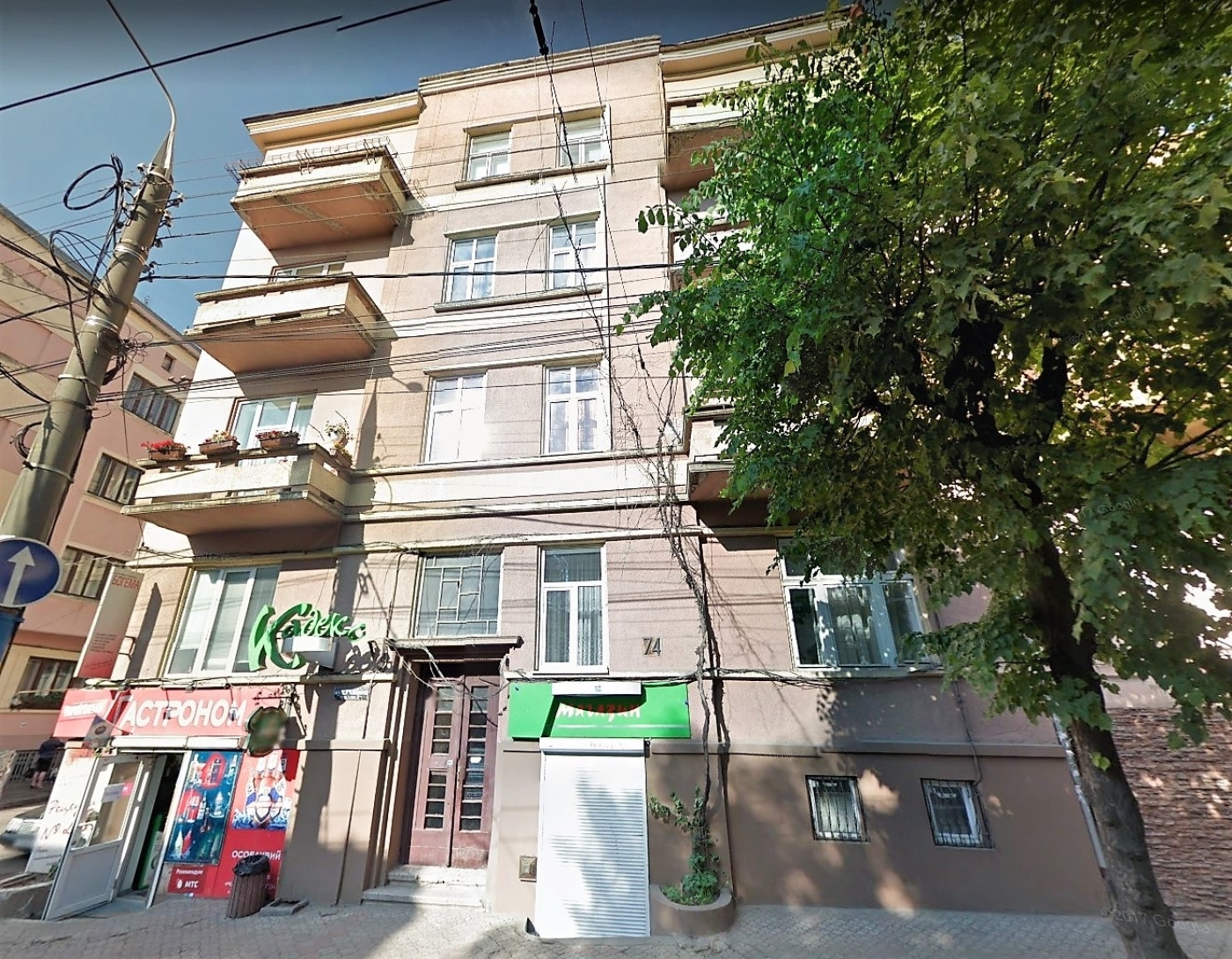
It had no permanent venue, so during the summer months - when the municipal theatre was closed - it performed mainly in garden pubs and later in the ballroom of the German House. The company also regularly toured Galicia and Romania. The authorities insisted that Abraham Axelrad, who ran the theatre with his wife Ruchel Axelrad (née Margules), confine himself to performing Jewish plays. When he applied for permission to stage “Singspiel performances, i.e. for a vaudeville theatre” (State Regional Archive Chernivtsi, F. 12, 1, 5046, p. 249), this was refused with reference to a similar establishment that had just been established.
After 1918, another Jewish theatre was established, but this is rarely documented in the local press in the form of announcements or reviews until 1923. It was directed by Max Reisch and is referred to in the press and archival documents as the “Jewish Theatre”, “Volksvariete”, “German-Jewish Cabaret” or “Jewish Pavilion Theatre”. Reisch, who gave his job title as “artist”, came from Sadagora and stayed in Chernivtsi during the third Russian invasion, where he ran a vaudeville theatre. In 1918 he tried to establish a “German-Jewish cabaret” in which “humorous performances were to be given by dignified singers” (Chernivtsi Regional State Archives, F. 12, 1, 1908, sheets 1 and 1b). From 1922, well-known Jewish theatre companies such as the “Wilnaer Theatertruppe”, the “Freie Jüdische Volksbühne” and the “Picon-Kalich-Truppe” began to perform in Chernivtsi, leading to extensive advance publicity and reviews in the press, where previously there had often been rejection or disinterest. The reorganisation of the Jewish Theatre Association by Max Diamant represented an opening of Jewish theatre to intellectual circles. However, the change in attitude was also linked to the upheaval and downsizing of the German theatre, which coincided with the beginning of the era of guest performances by Jewish theatre companies in Chernivtsi in 1922. A fault line between Jewish and German culture was now also perceived by formerly German-acculturated Jews, which in part led to tendencies of demarcation within the independent and bourgeois press.