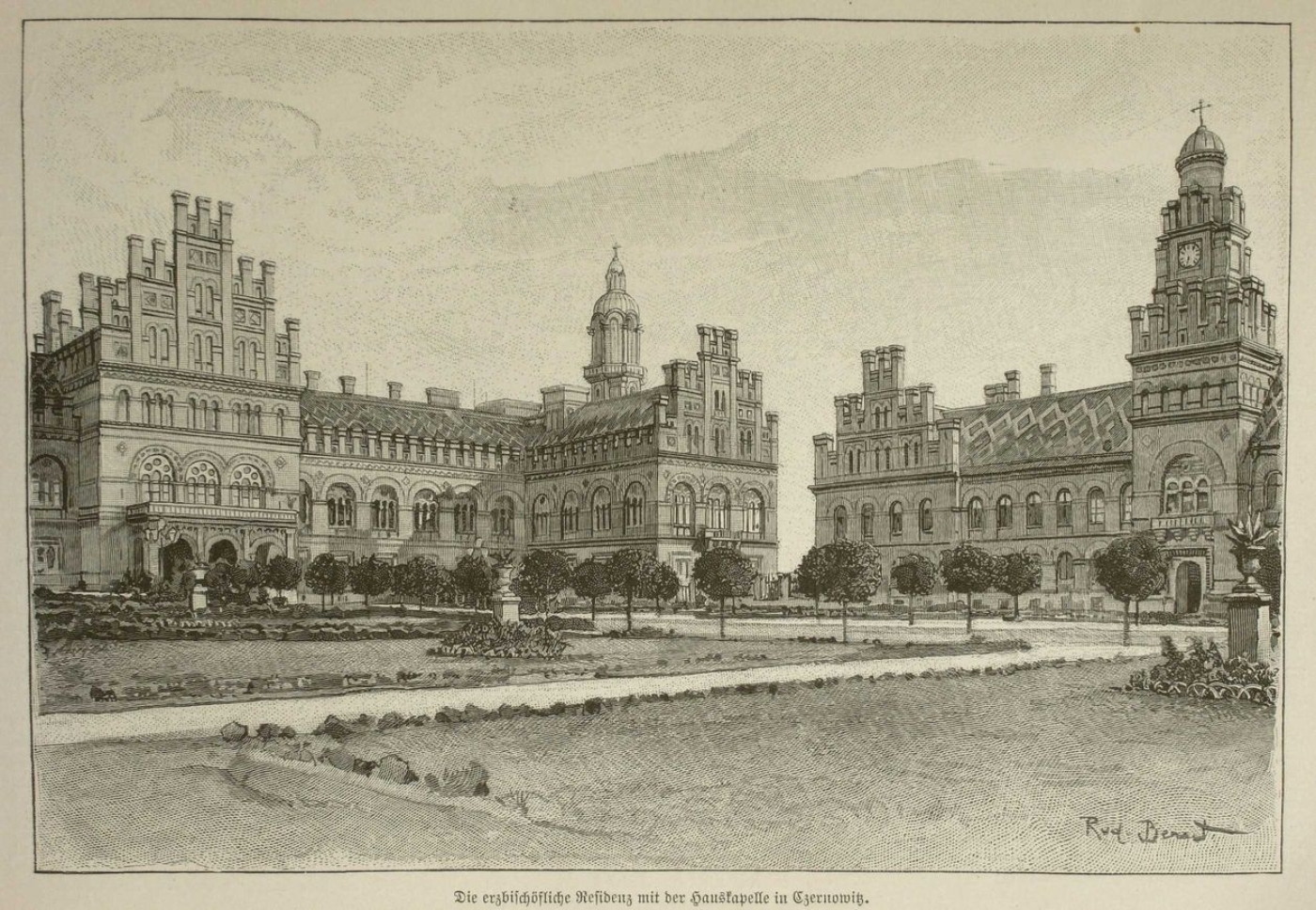
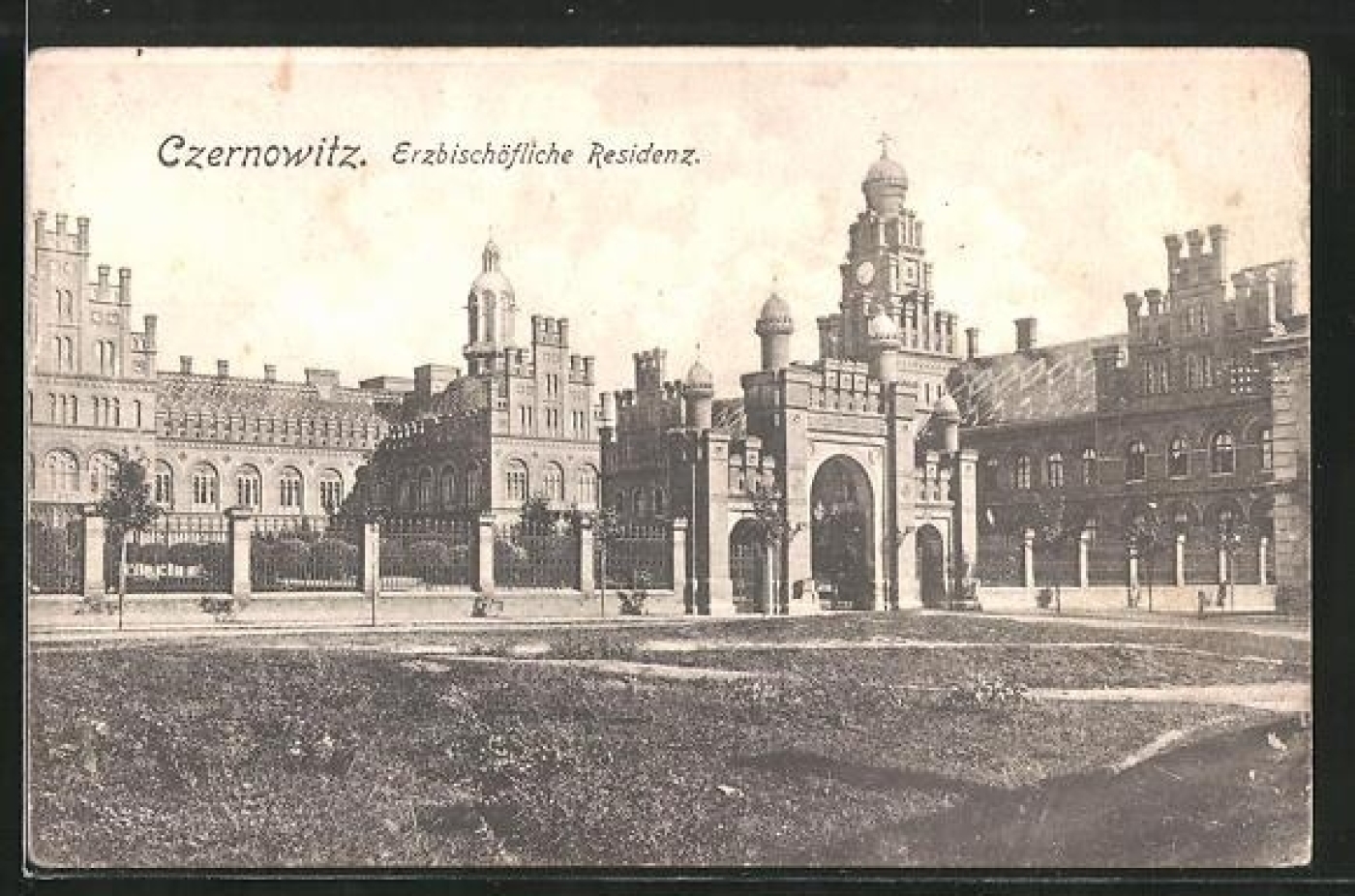
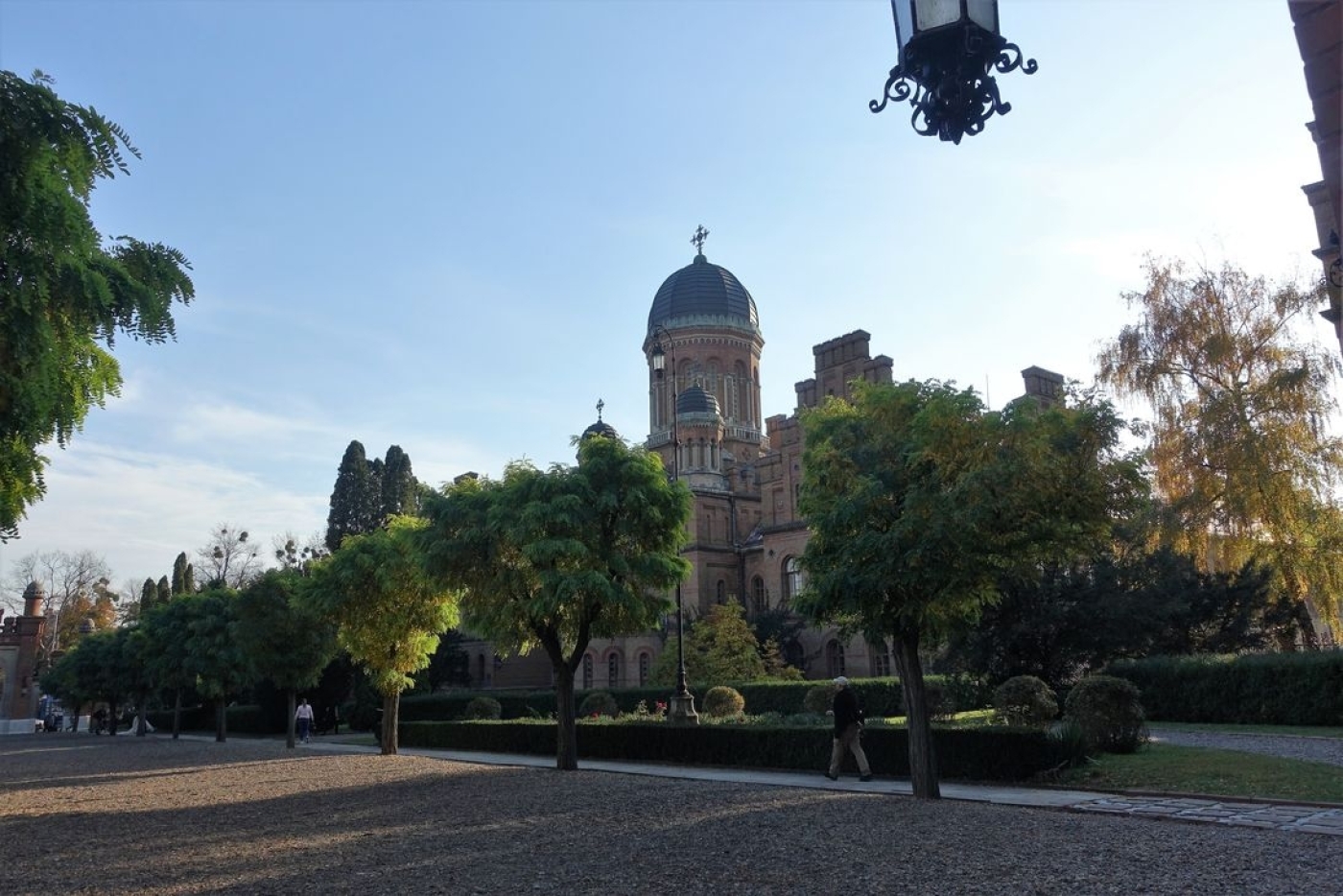
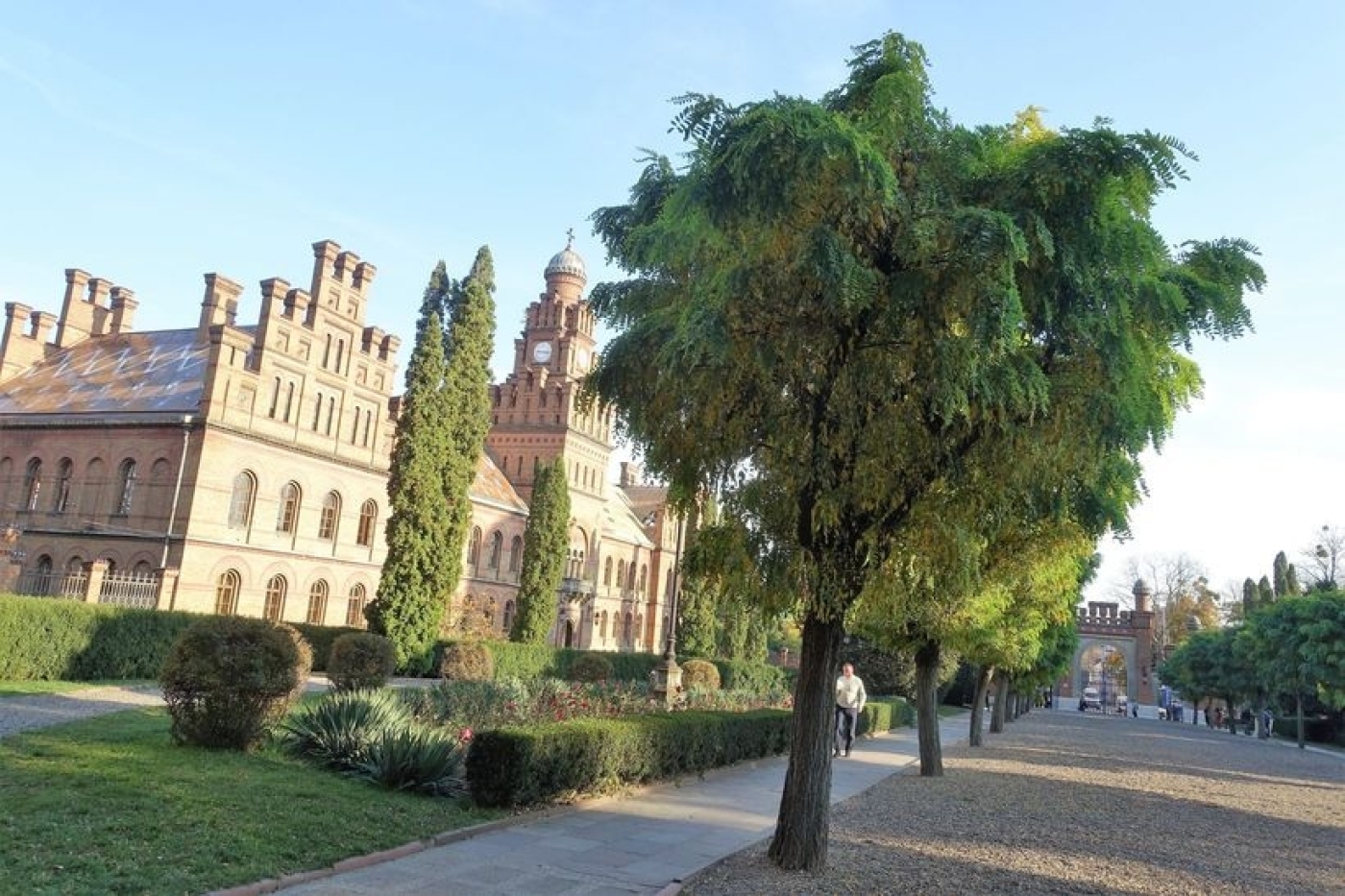
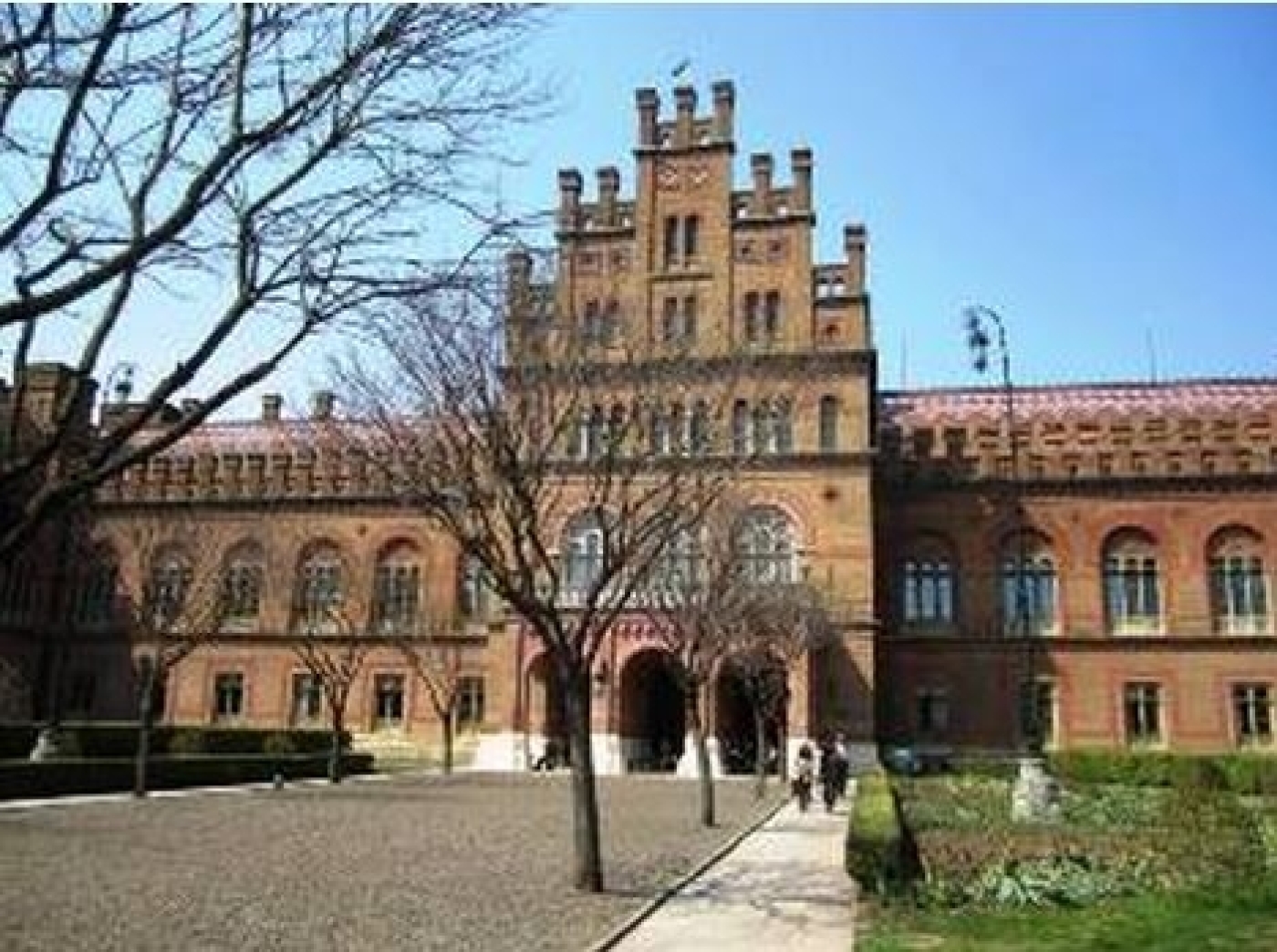
The ensemble is situated on a small hill, the so-called Bishop's Hill, at the end of Universitätsstrasse, about a kilometre north-west of the city centre (Seemann, 9). The 70 x 100 metre forecourt is bordered on three sides by the red-brick residential buildings: On the left is the seminary wing with the Orthodox seminary church. To the right is the Metropolitan Palace, with its imposing façade and stepped gable. To the right, the square is completed by the Guest House with its characteristic clock tower. The architecture of the whole ensemble has Moorish, Byzantine, Romanesque and Gothic elements. The steep roofs are covered with colourful glazed tiles in the Bukovinian style (UNESCO, 6 ff., and Anders, 276).
The Seminary Church is dedicated to the three holy hierarchs, St Basil the Great, St Gregory Nazianzen and St John Chrysostom. It is Byzantine in style, with a cross vault and, besides a magnificent iconostasis, it is decorated with wall paintings by famous Viennese and Bukovina artists (UNESCO, 35, and Anders, 276). The central wing of the building, the palace, housed the apartments of the metropolitans and four magnificent halls: The Synod or Marble Hall, with several galleries supported by alabaster columns and carved wooden panelling on the ceiling, served as a meeting room for the bishops. The frescoes and mosaics on its walls depict significant moments in the history of Bukovina and the Orthodox Church. The Red Hall served as a smaller meeting room and was decorated with wood and Chinese silk. The Blue Hall housed the library, and the Green Hall served as a reception room for the Metropolitan's guests (UNESCO, 34f.). Behind the Metropolitan Palace is a large park laid out in the English style by Viktor Paul and Herman Langer between 1876 and 1878, with a bust of Josef Hlávka at the entrance (UNESCO, 31). Archbishop Eugen Hackmann (1793-1873) himself initiated the construction of the residence in 1863 and commissioned the architect Hlávka, who had become famous for his work on the Vienna Court Opera, to carry out the project. The building, which cost several million gulden, was financed by the Greek-Oriental Religious Fund (Josef Gregor: Zur Geschichte des Residenzbaues. In: Czernowitzer Allgemeine Zeitung, No. 3403, 21 March 1914, p. 1, and Philipp Menczel: Czernowitz. Ein Stadtbild. In: Czernowitzer Allgemeine Zeitung, No. 1407, 20.09.1908, p. 1).
In 1872, Archbishop Hackmann gave his consent to the Viennese government to house several faculties of the planned university in the so-called priest's or guest house, the eastern flank building of the archbishop's residence (Academic Senate, 37).
The availability of the spacious premises was one of the most important arguments for Vienna's decision to choose Chernivtsi over other cities in the Habsburg Empire such as Trieste, Brno or Ljubljana as the site for the foundation of a new German-language university (Masan, 156, and Stourzh, 54f.).
Although the residence had originally been built for the metropolitans, the highest-ranking bishops, of Bukovina and Dalmatia, the Greek theological school founded in Chernivtsi a year earlier had already been given a place in the seminary building of the newly built archbishop's residence in the autumn of 1870 (Masan, 156).
In 1875 this school became the Faculty of Theology of the newly founded Franz Joseph University, and the Faculties of Law and Philosophy, as well as the Departments of Zoology, Botany, Mineralogy, Chemistry and Physics, were also allocated seminar rooms in the Residenz. However, they often complained 'about the inadequacy and unsuitability of the premises' (Academic Senate, 52).
Under the Soviet regime, the Archbishop's Residence was nationalised after the Second World War. After renovation, it first housed the Historical and Regional Museum and, from 1955, the University (Masan, 157). When the Residence was inscribed on the World Heritage List in 2011, most of the university's facilities were removed to allow the development of a tourist infrastructure, including a UNESCO office, a museum, a café and shops. The Faculty of Philosophy and Theology and the Faculty of Philology are still located in the seminary wing, and the Faculty of Geography and Tourism in the guesthouse. The main building still houses the university administration, the International Office, the DAAD Lektorate and the Gedankendach Cultural and Scientific Centre, which is funded by the Goethe Institute.
Text: Tabea Schleinitz
Materials:
- Ada Anders: Ukraine. DuMont Reise-Handbuch. Ostfildern 2012
- Akademischer Senat (Hrsg.): Die K. K. Franz-Josephs-Universität in Czernowitz im ersten Vierteljahrhundert ihres Bestandes. Festschrift. Czernowitz 1900, S. 37. Verfügbar unter: http://hauster.de/data/almamaterfrancis.pdf [Zugriff: 24.09.2017]
- Josef Gregor: Zur Geschichte des Residenzbaues. In: Czernowitzer Allgemeine Zeitung, Nr. 3403, 21.03.1914, S. 1
- Oleksandr Masan: Czernowitz als regionales Zentrum. In: Harald Heppner (Hrsg.): Czernowitz. Die Geschichte einer ungewöhnlichen Stadt. Köln 2000, S. 145-166
- Philipp Menczel: Czernowitz. Ein Stadtbild. In: Czernowitzer Allgemeine Zeitung, Nr. 1407, 20.09.1908, S. 1
- Helfried Seemann: Czernowitz und die Bukowina: 1890-1910. Wien 2001
- Gerald Stourzh: Die Franz-Josephs-Universität in Czernowitz, 1875-1918. In: Richard Georg Plaschka, Karlheinz Mack (Hrsg.): Wegenetz des europäischen Geistes. Wissenschaftszentren und geistige Wechselbeziehungen zwischen Mittel- und Südosteuropa vom Ende des 18. Jahrhunderts bis zum Ersten Weltkrieg. Wien 1983, S. 54-59
- UNESCO World Heritage Centre (Hrsg.): The Residence of Bukovyna and Dalmatia Metropolitans in Chernivtsi, http://whc.unesco.org/uploads/nominations/1330.pdf [Zugriff: 24.09.2017]