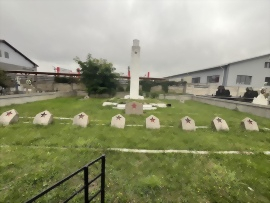
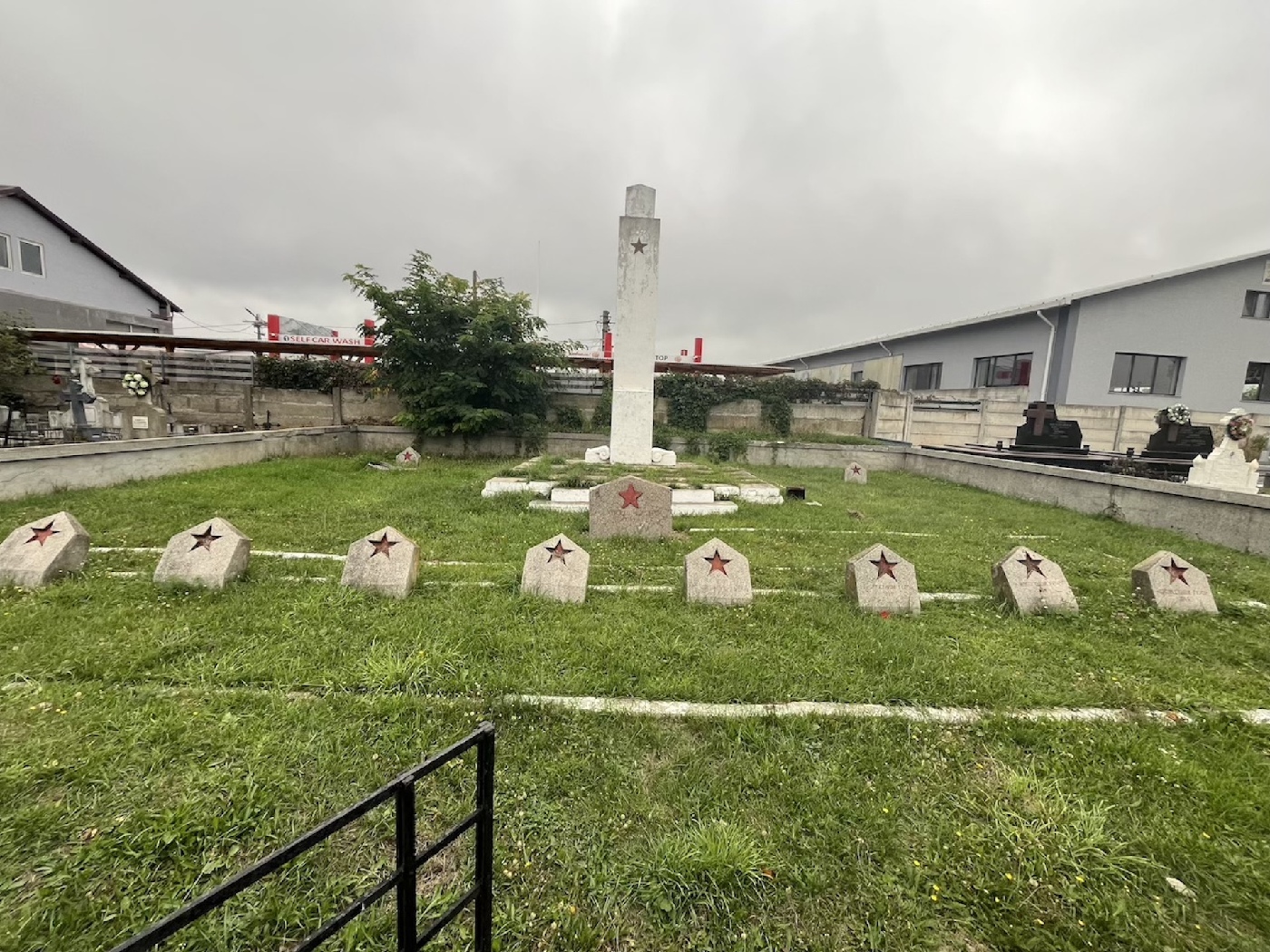
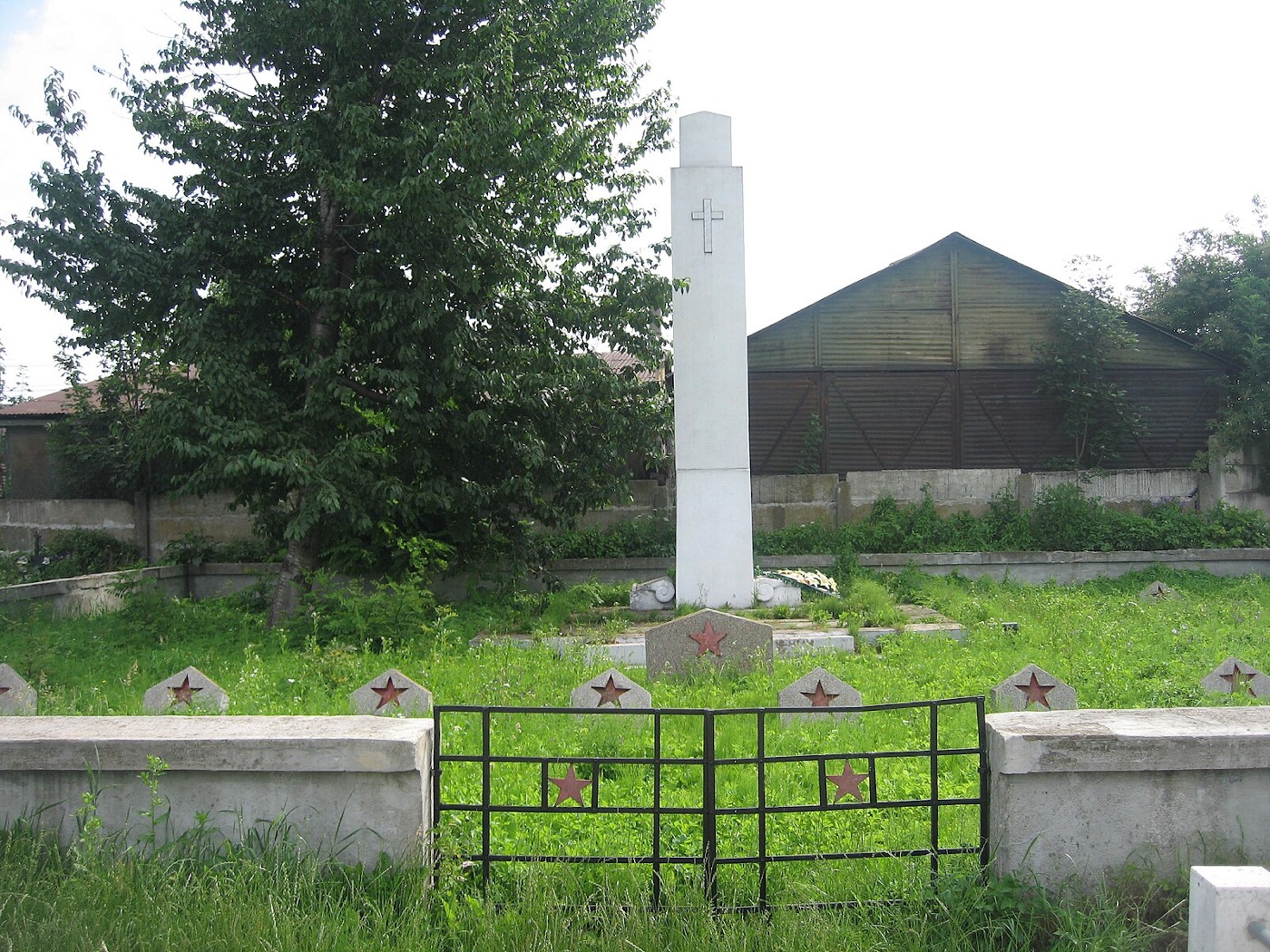
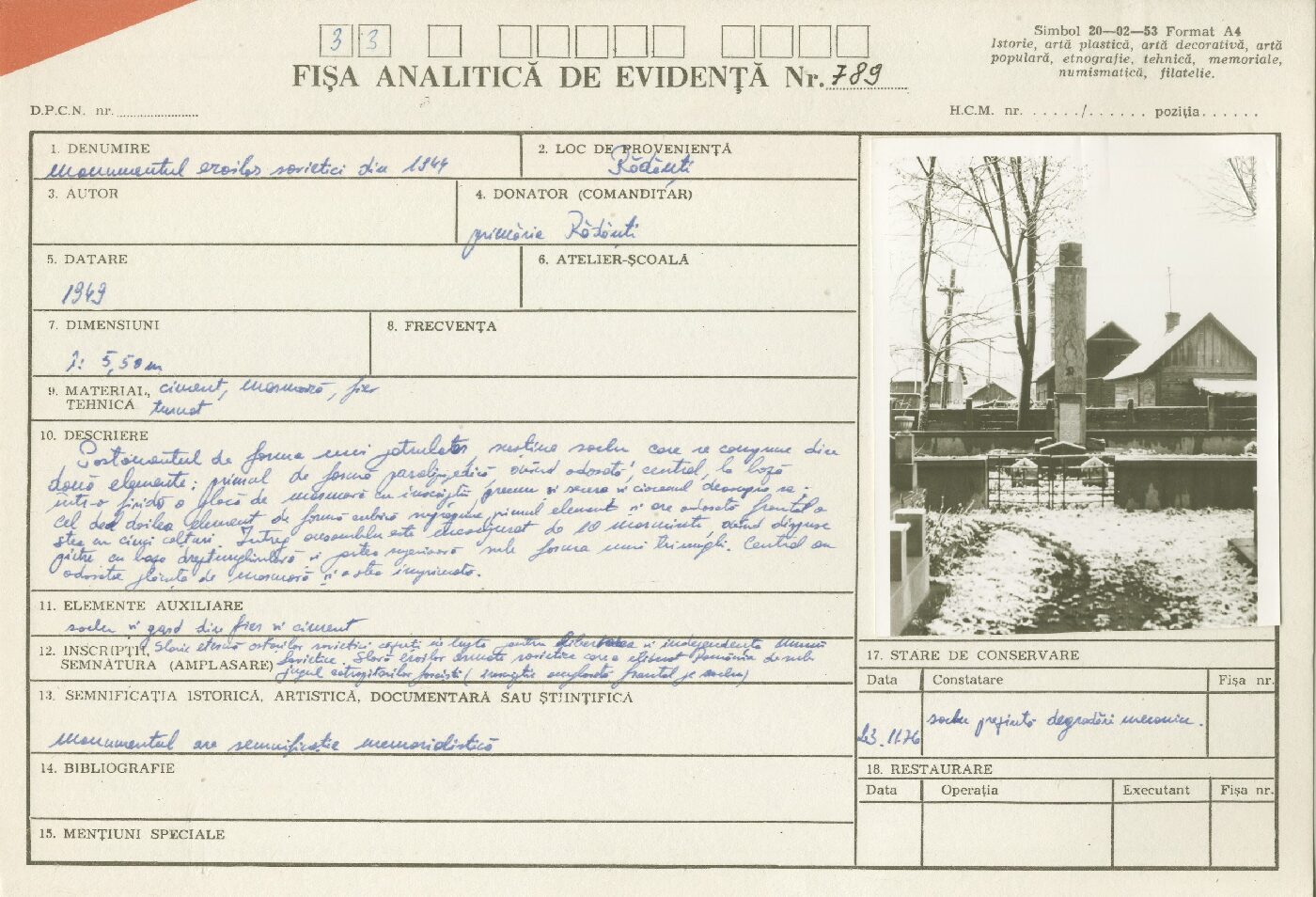
The memorial consists of a group of eleven gravestones and a central obelisk. The obelisk is painted white and, apart from two ornaments at its base, is plain. The group is surrounded by a low wall, which is accessed through a double gate. Eight gravestones form the first row, with another standing in the center of the second row. Behind them stands the obelisk, raised by a single step. In the two corners behind the obelisk are two additional gravestones. Each gravestone, as well as the obelisk and the gate wings, bears a red, five-pointed Soviet star. The gravestones each bear the red inscription “неизвестный герой 1944,” which means “nameless” or “unknown hero of 1944.” According to the AFCN (Administrația Fondului Cultural Național) registry, the obelisk is 5.50 meters high.
The memorial dates from the Soviet occupation period. It must have been built sometime after 1944 (based on the inscriptions on the gravestones) and before the establishment of the communist government in Romania in March 1945. The architects are unknown. A record on the AFCN website notes that the monument was originally fitted with an inscribed marble slab. This slab is no longer present today. The following text was inscribed on the marble slab of the obelisk in 1949:
GLORIE ETERNĂ OSTAȘILOR SOVIETICI CĂZUȚI ÎN LUPTA PENTRU ELIBERAREA ȘI INDEPENDENȚA UNIUNII SOVIETICE. SLAVĂ EROILOR ARMATEI SOVIETICE CARE A ELIBERAT ROMÂNIA DE SUB JUGUL COTROPITORILOR FASCIȘTI
[Eternal glory to the Soviet soldiers who fell in the struggle for the liberation and independence of the Soviet Union. Glory to the heroes of the Soviet Army who liberated Romania from fascist oppression]
This source describes the condition of the monument as ‘relatively well-preserved’. In a photograph from 2009, the wall and gate show signs of weathering, while the obelisk still appears to be in relatively good condition. No marble plaque is visible in the photo, which means it was removed between 1949 and 2009. Instead, a Christian cross is located at the top of the obelisk. Flowers lie at the base of the obelisk on the right side. Photographs from September 24, 2025, document a further change: the cross has been removed and replaced by a red Soviet star. The obelisk now shows significant signs of weathering.
Text: Laura Lindner.
Sources:
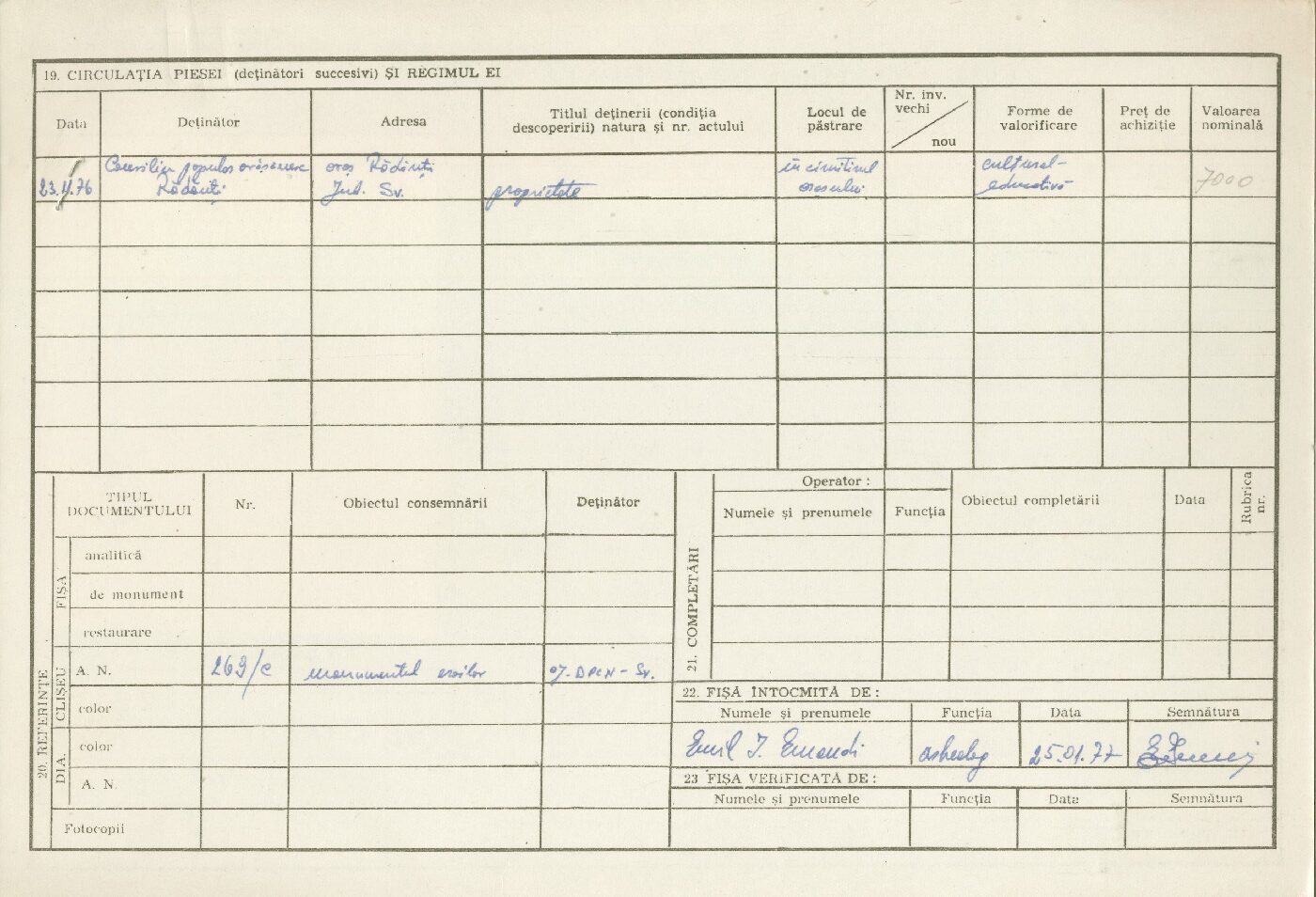
- Administrația Fondului Cultural Național (AFCN) (2025): Back-up. Galeria monumentelor de for public. Recuperarea fișelor analitice de evidență din Fișierul Central al Patrimoniului Cultural. Online verfügbar unter https://eroi.cimec.ro/monument-al-militarilor-sovietici-cazuti-in-al-doilea-razboi-mondial-cimitir-obelisc-radauti-2855/, zuletzt geprüft am 09.02.2026.
- Rusu, Mihai Stelian und Alin Croitoru. „Memorial ambivalences in postcommunist Romania: generational attitudes towards the symbolic legacy of communism“. Societies 11, Nr. 3 (2017): 1–15.
- Dobre, Claudia-Florentina. „Pasts into Present: Ideology, Memory, and Monuments in Communist and Post-communist Romania“. Sensus Historiae© 24, Nr. 3 (2014).