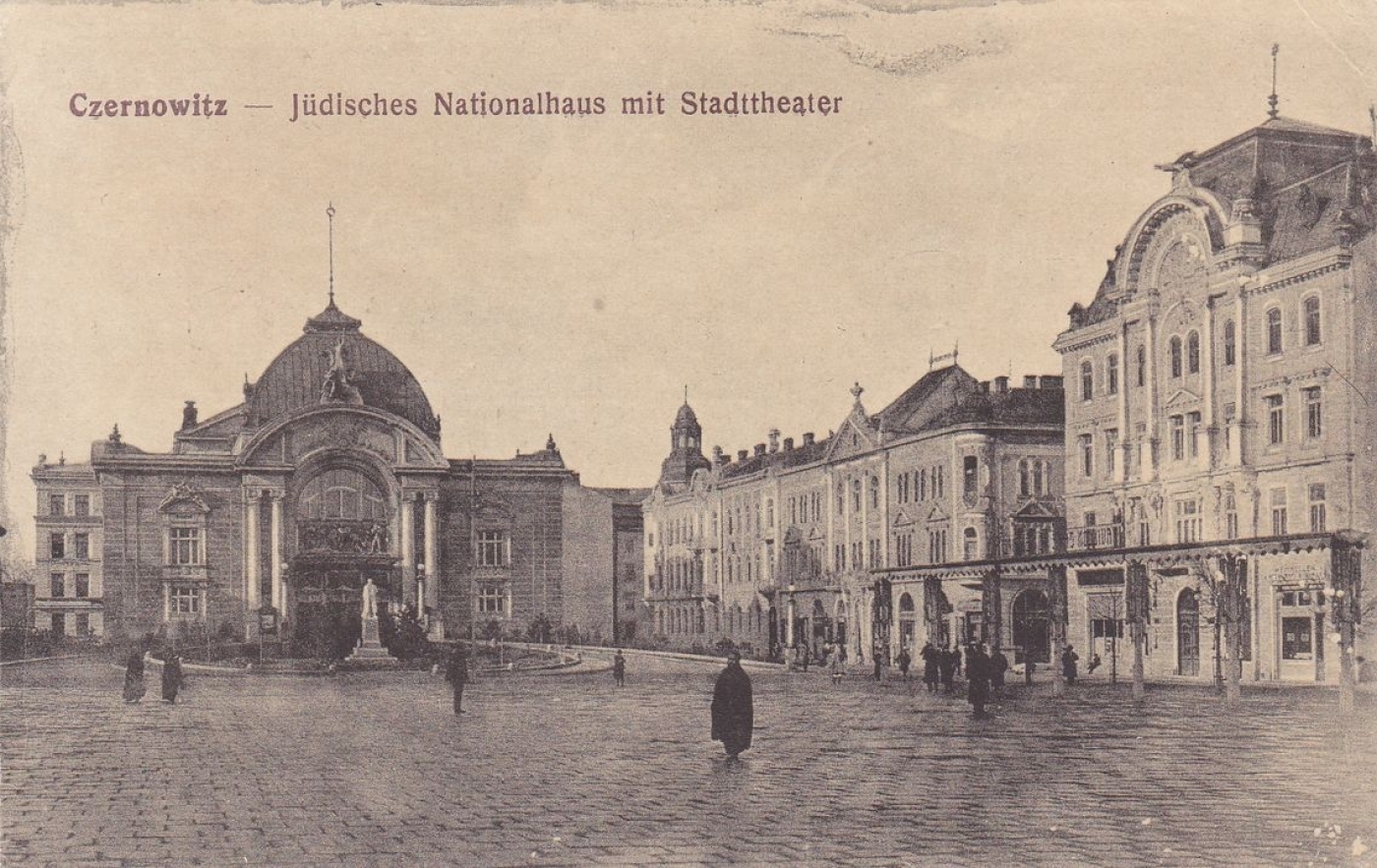
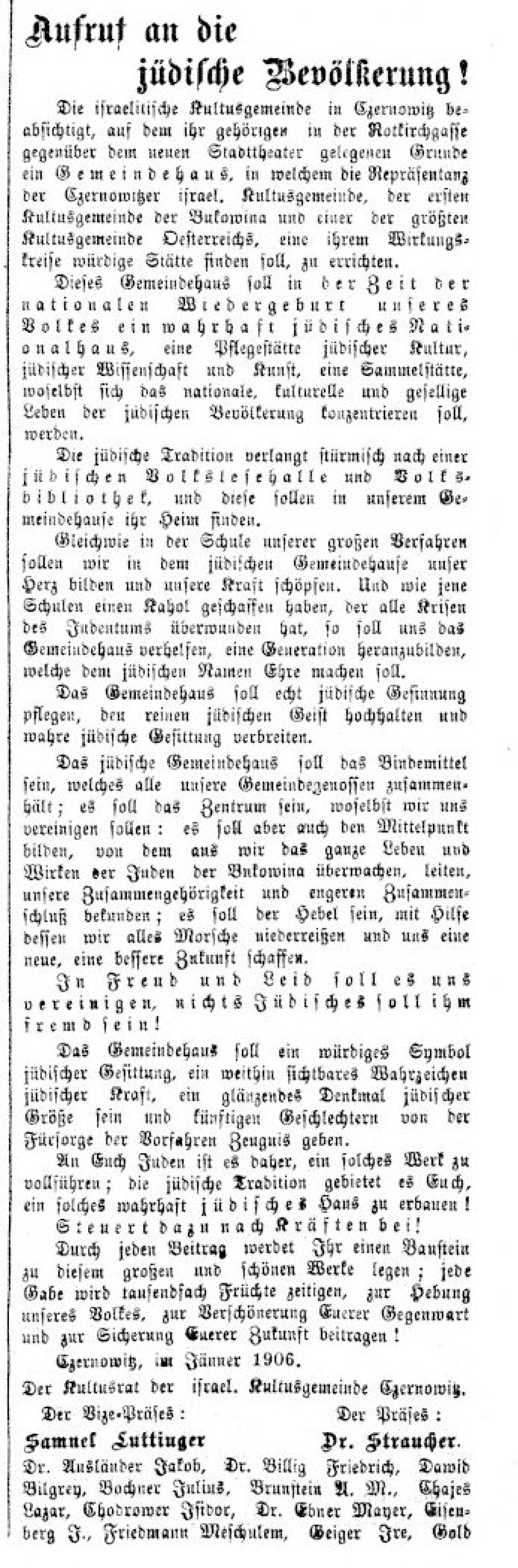
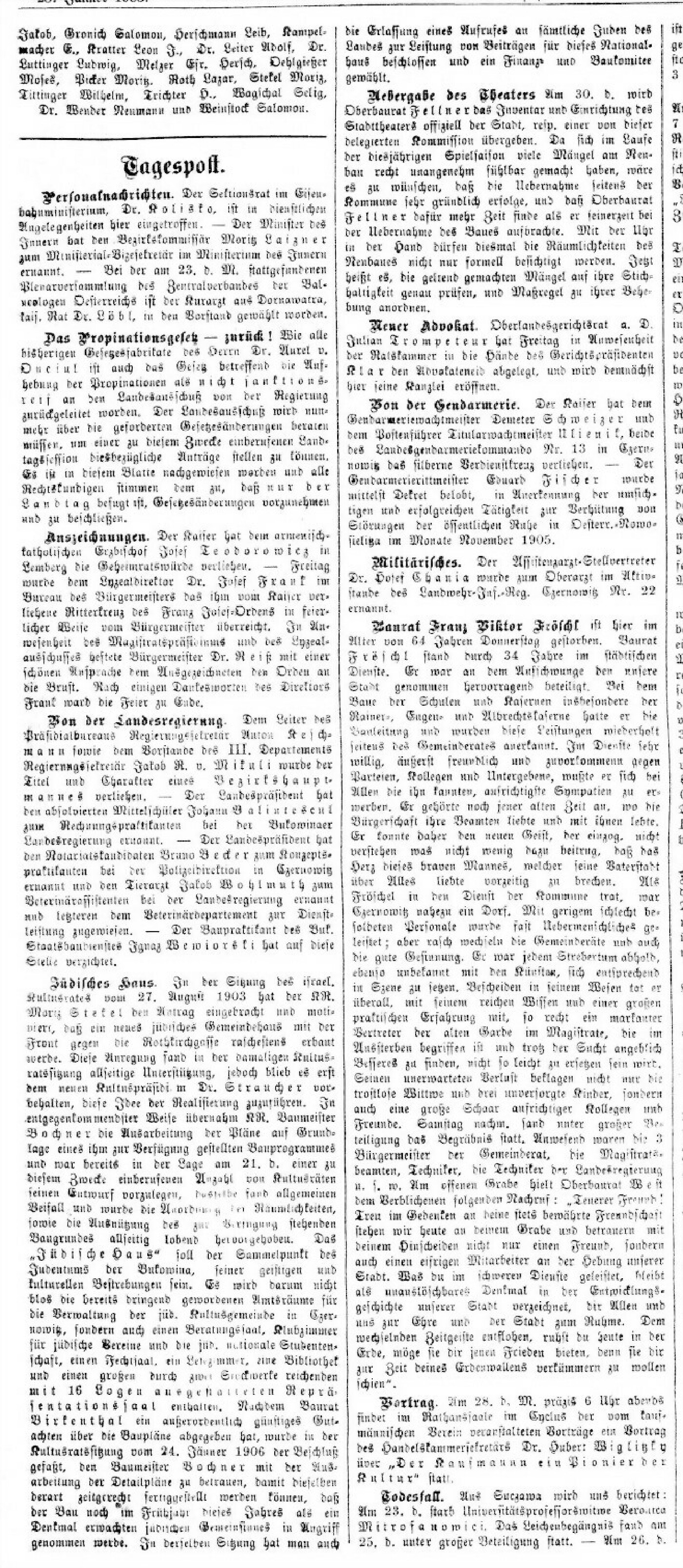
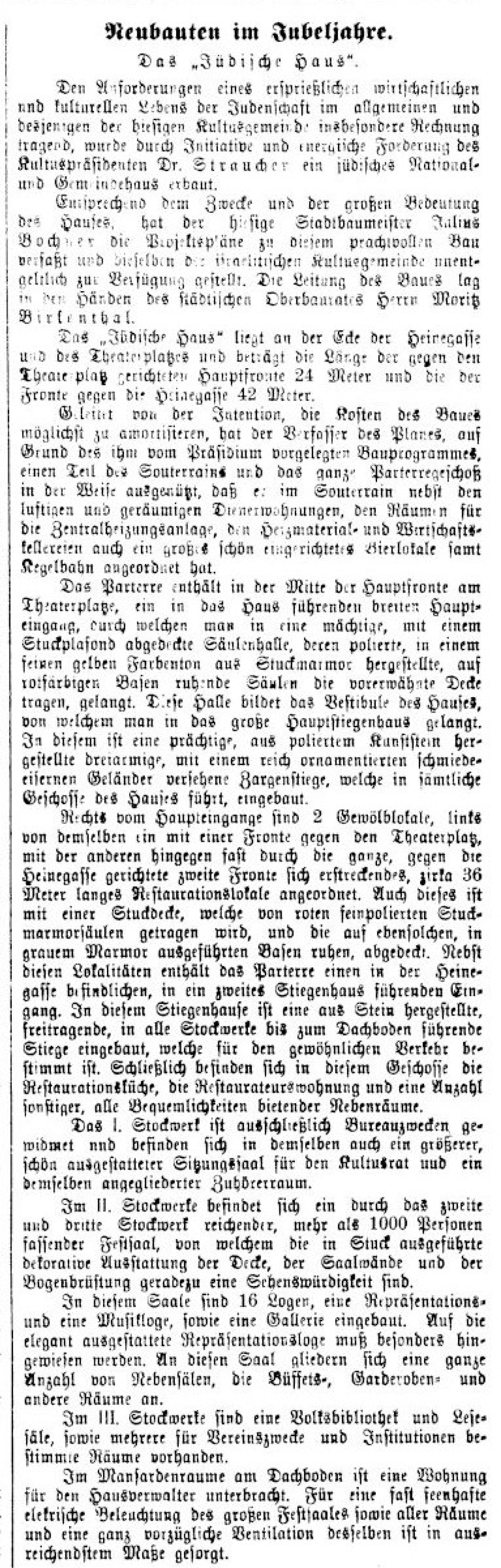
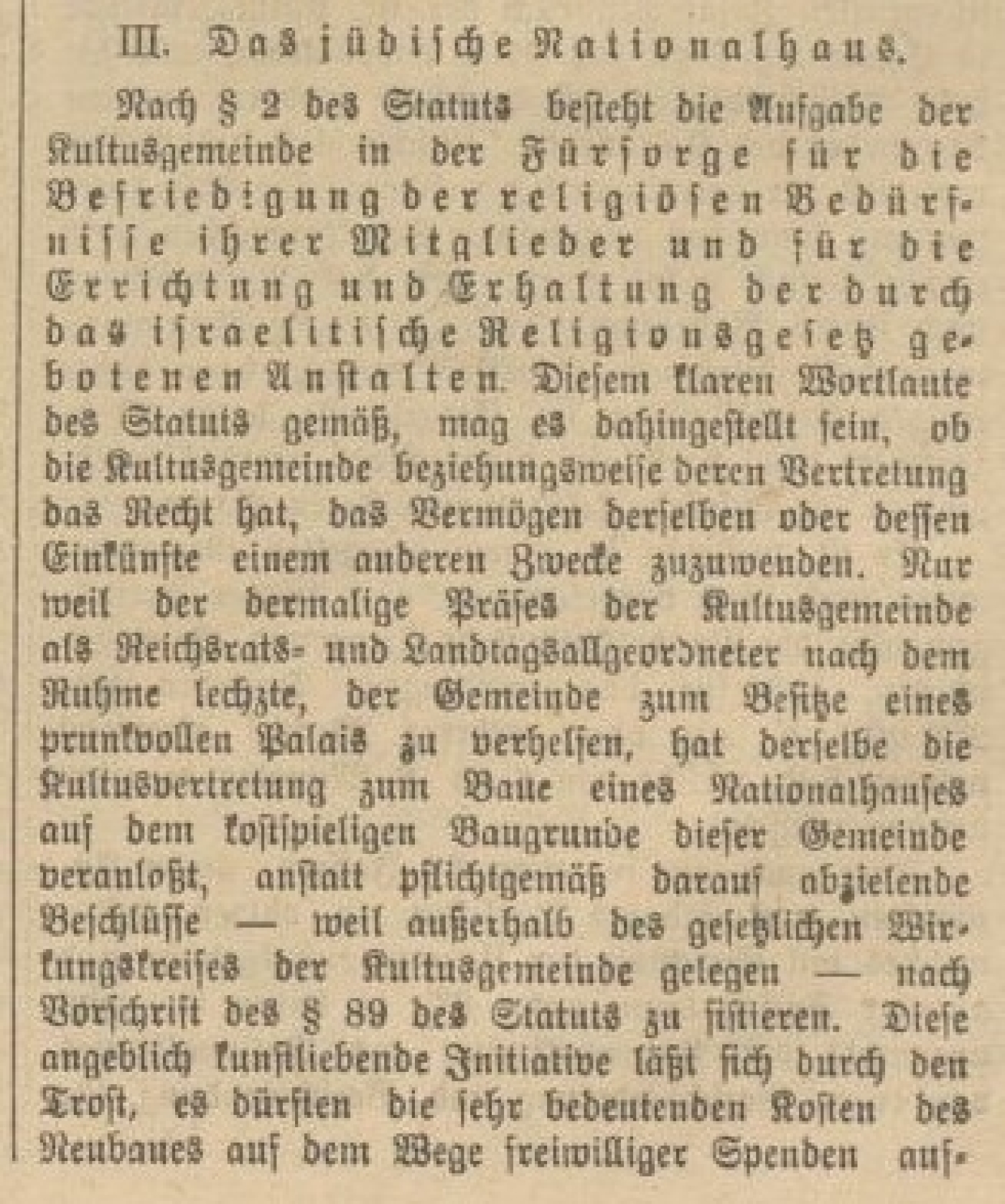
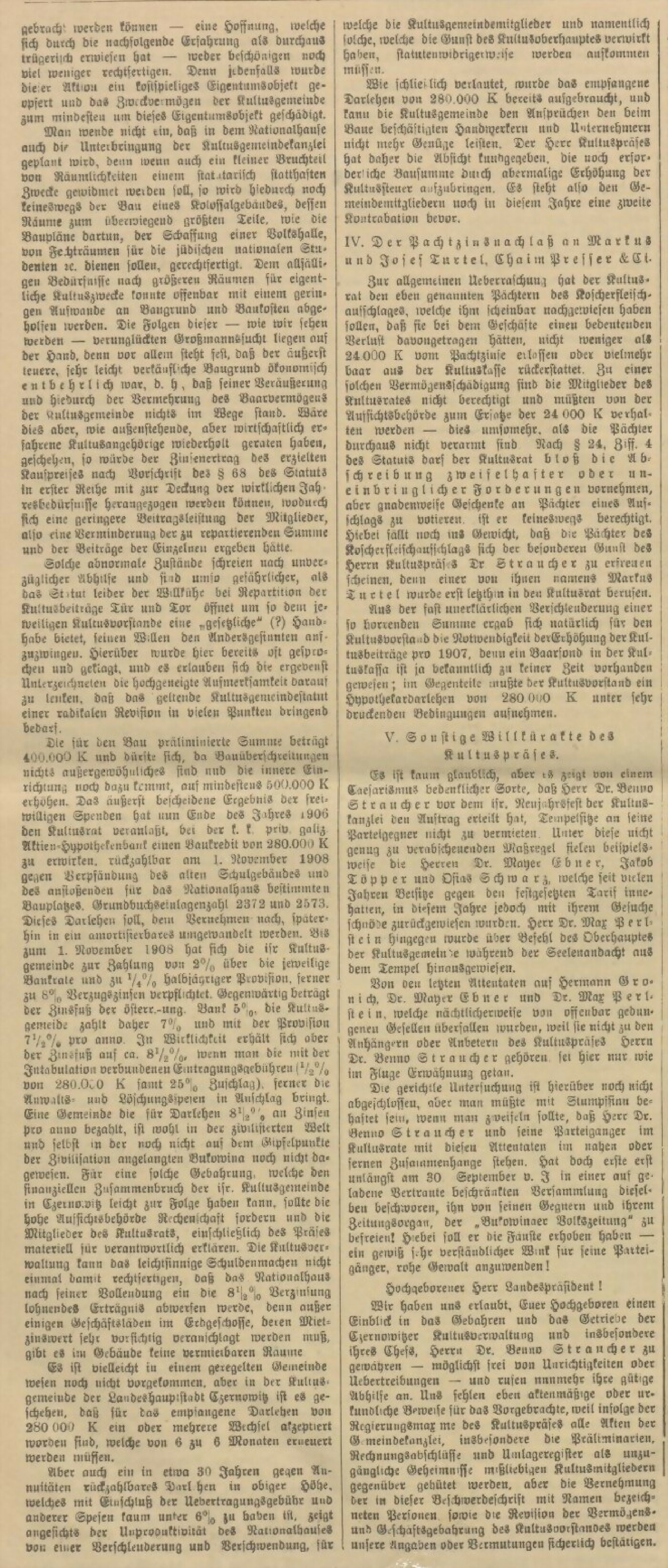
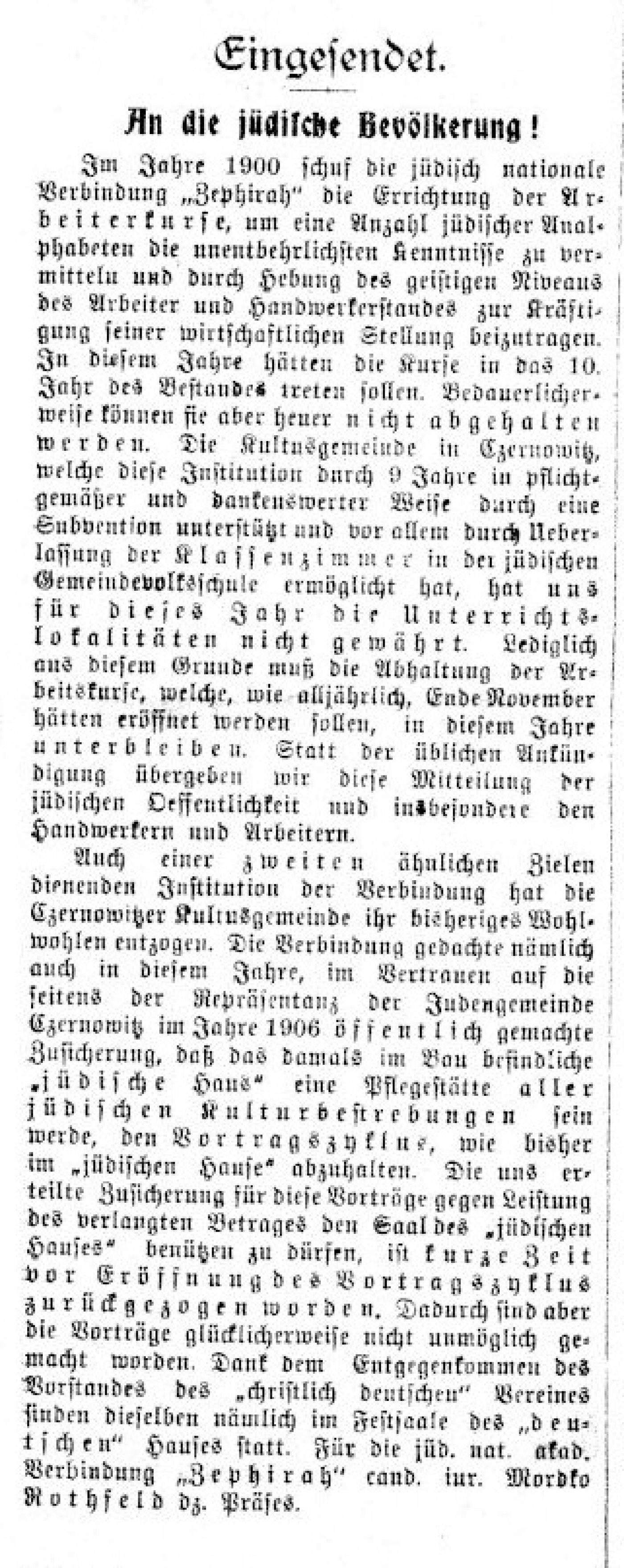
The history of planning and development: On 27 August 1903, the religious council of the Jewish community submitted an application to build a Jewish house, which was supported but not taken up until two and a half years later. In January 1906, the Jewish community in Chernivtsi announced its plans to build a Jewish house and asked for financial support. The planned house was to be “a truly Jewish national house in the time of the national rebirth of our people, a place for the cultivation of Jewish culture, Jewish science and art, a meeting place where the national, cultural and social life of the Jewish population would be concentrated” (Bukowinaer Post, 28 January 1906, p. 4). The building, 24 metres wide and 42 metres long, was designed by master builder Julius Bochner and built under the supervision of Moritz Birkenthal, the city's chief architect. It has five floors. The basement housed staff apartments and a pub, while on the ground floor there was a “mighty columned hall with a stucco ceiling”, which formed the building's vestibule and from which the staircase was accessed.
The first floor was reserved for offices and the Parish Council meeting room. The second and third floors housed the banqueting hall, which could seat more than 1,000 people and had 16 boxes, a representation and music box and a gallery. Adjacent to this hall were other rooms, the buffet room, a cloakroom and other rooms. The third floor contained a public library and reading rooms. There were also rooms for various clubs and institutions. The manager's apartment was in the attic (Czernowitzer Allgemeine Zeitung, 4 October 1908, p. 3).
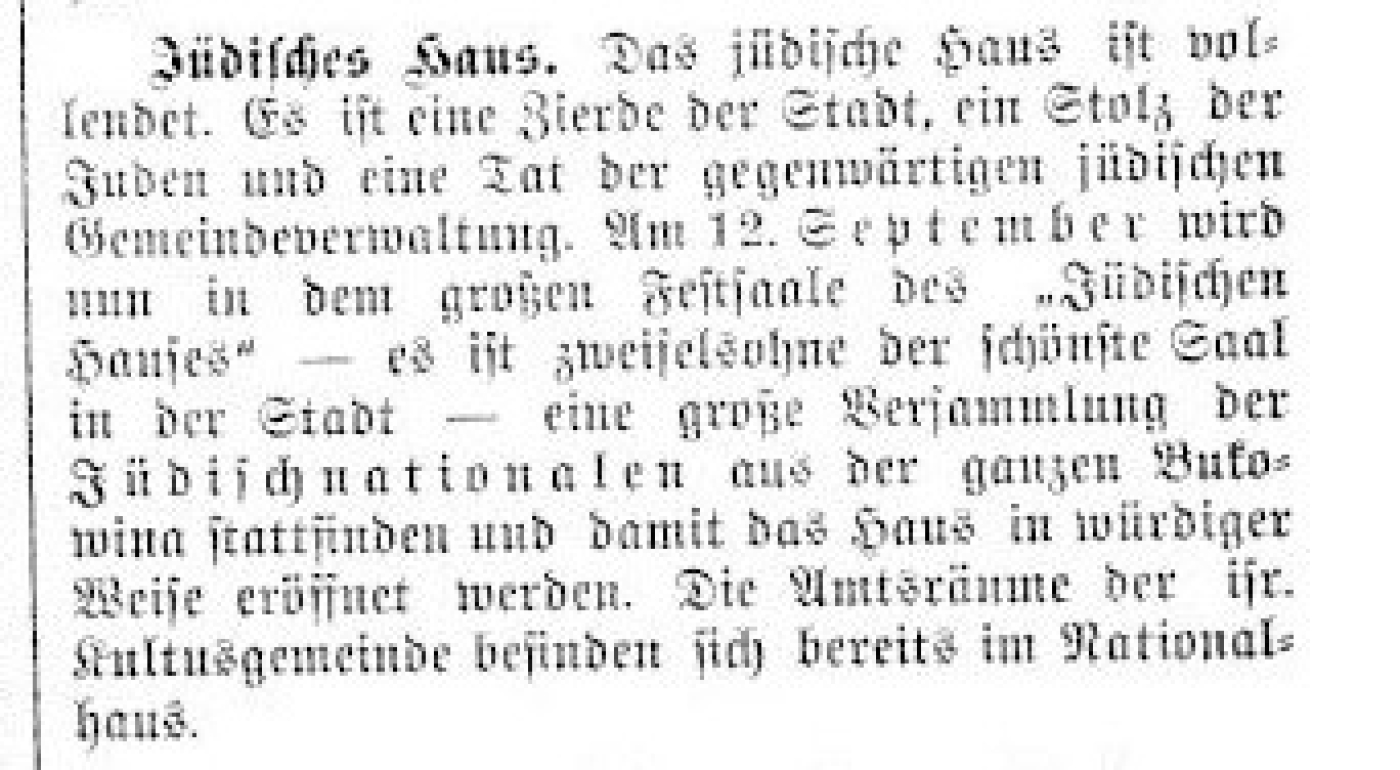
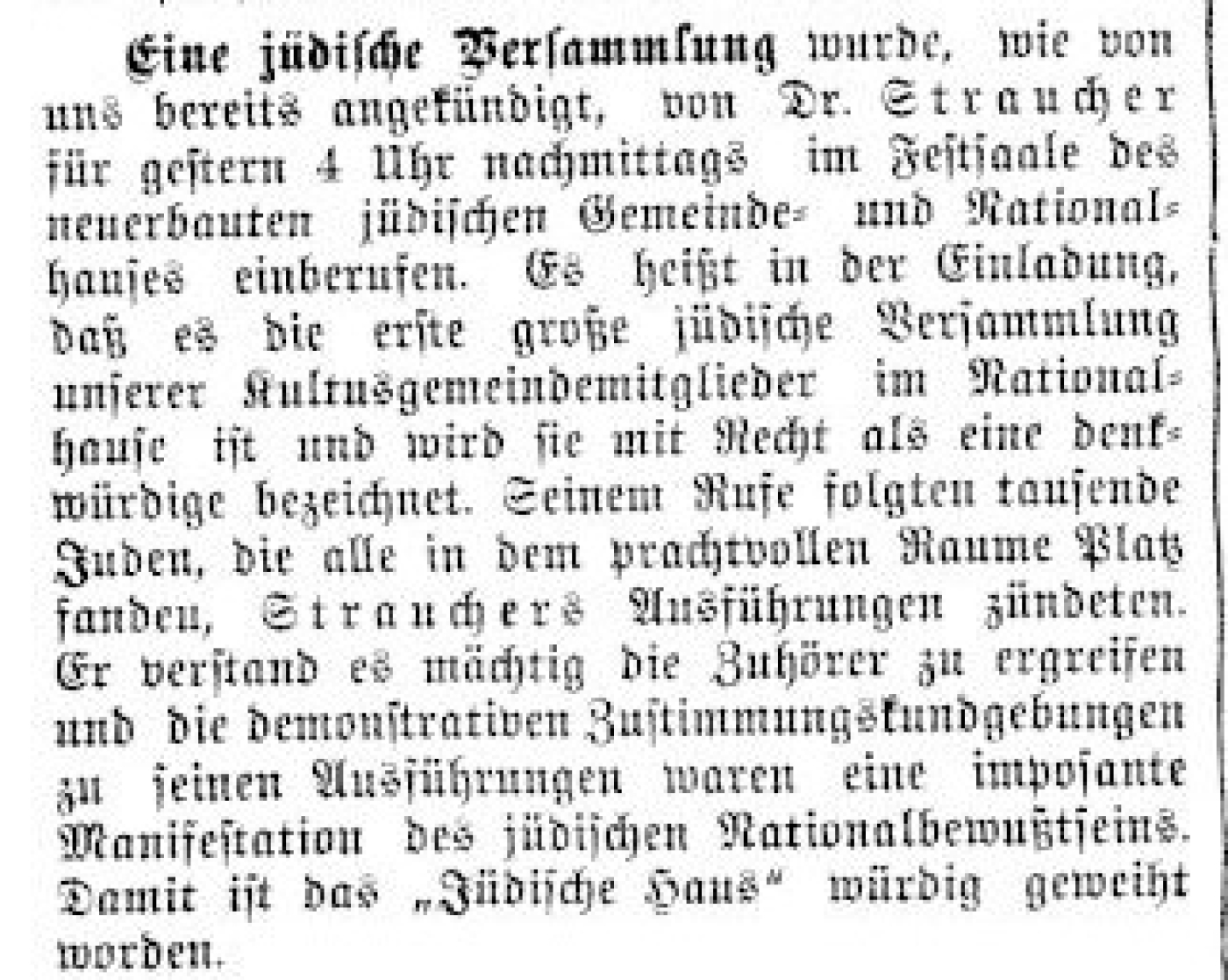
The house was opened on 12 September 1908 with a “large gathering of Jewish nationalists from all over Bukovina” (Bukovinaer Post, 6 September 1908, p. 5). According to one reporter, the speech by Benno Straucher, chairman of the community and a member of the Reichsrat, was an “impressive manifestation of Jewish national consciousness” (Bukowinaer Post, 13 September 1908, p. 5). The Israelite Religious Community, on whose initiative the construction was based - with Straucher playing a decisive role - had already moved into its offices in the new building.
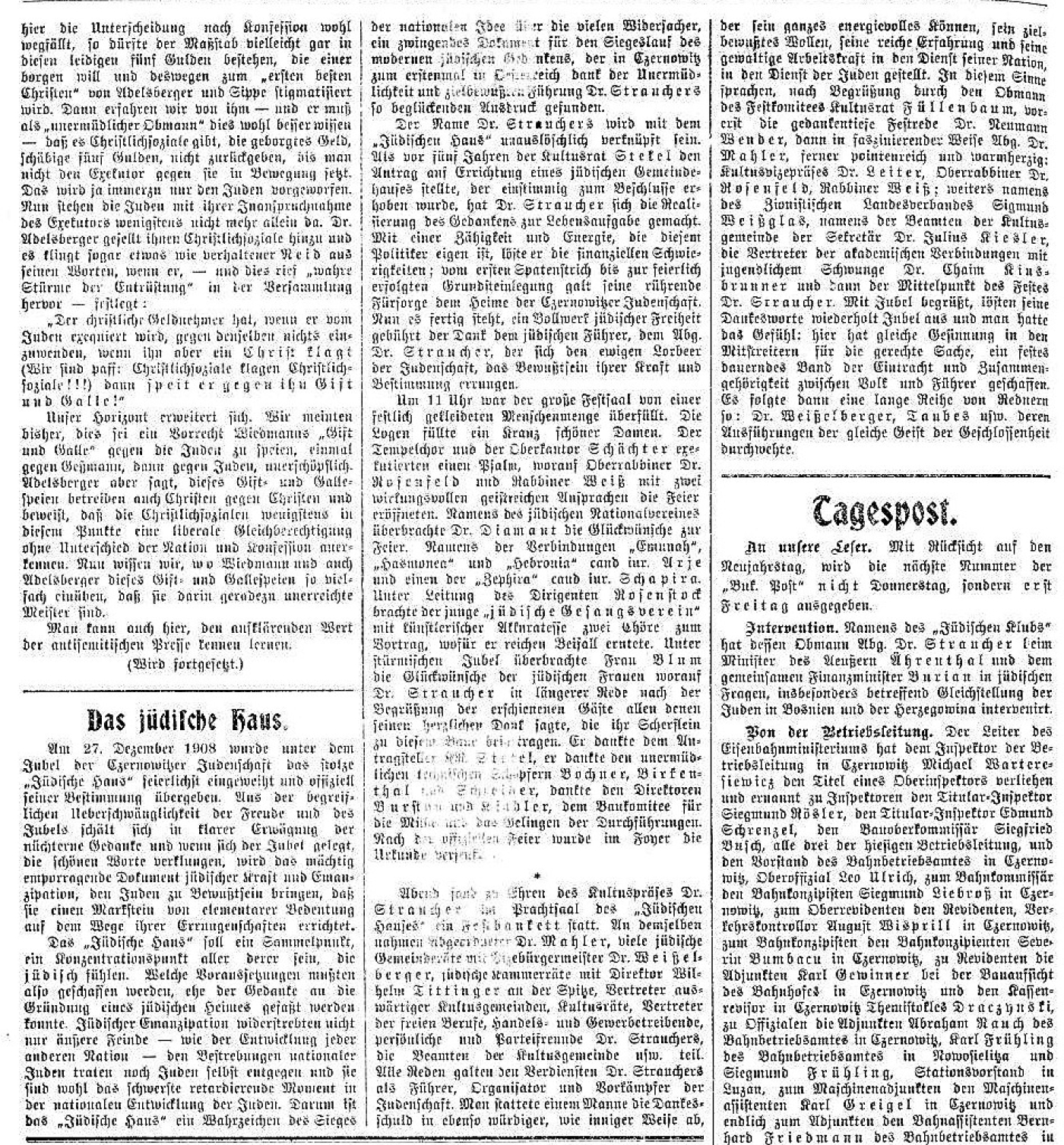
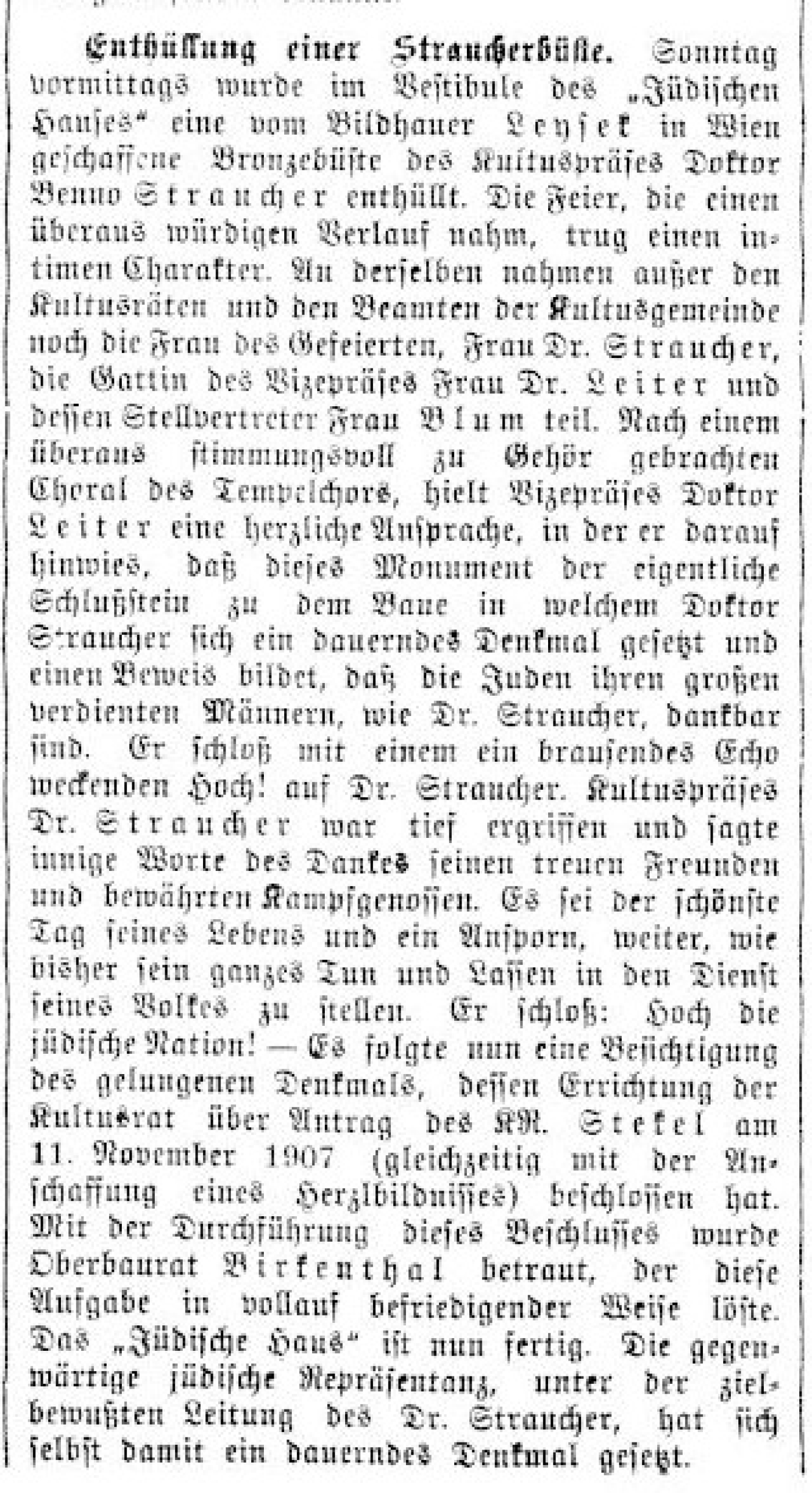
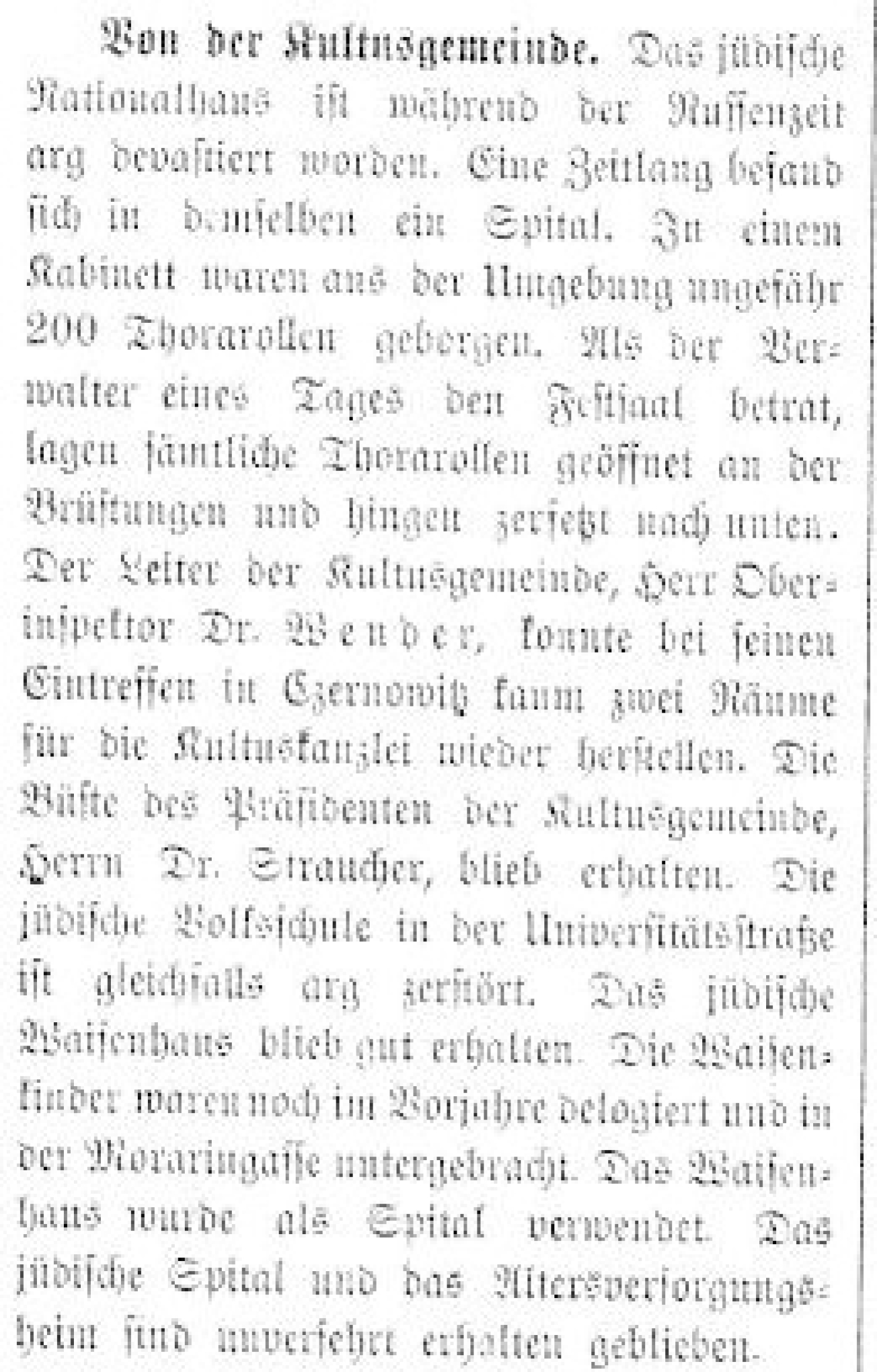
On 27 December 1908, the building was finally inaugurated and officially dedicated. From then on, and throughout the inter-war period, it was an important place of reference for the Jewish population, but it was also often at the centre of political debates between the various Jewish groups in the city. Benno Straucher, who had his own bust erected on the ground floor in 1909, banned some Jewish nationalist academic associations from using the building. The Jewish Toynbee Hall, opened in 1913 on the initiative of Leon Kellner, one of Straucher's opponents, was also an expression of the progressive differentiation of the Jewish community, at least of the politically and culturally active classes.
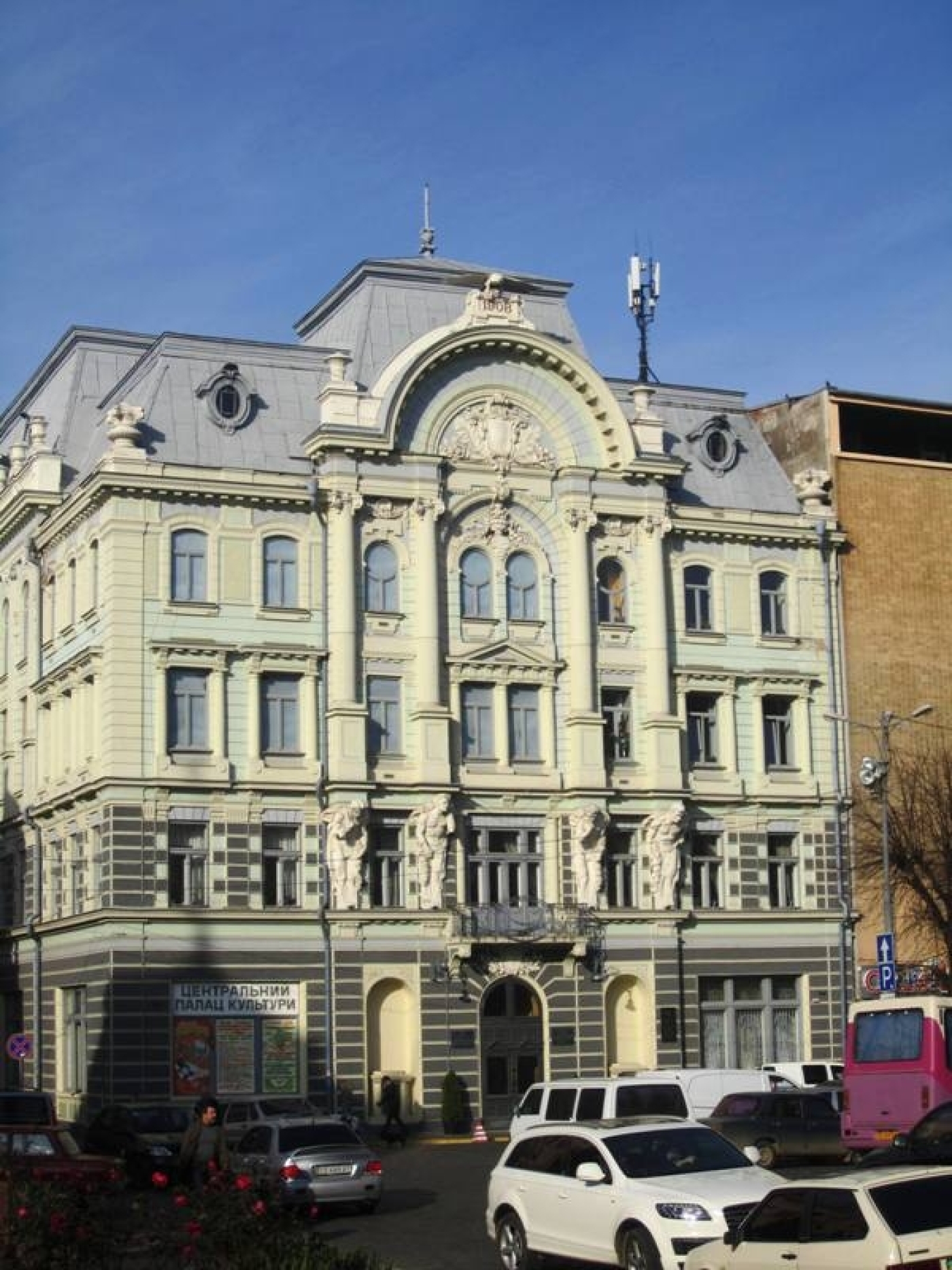
Externally, the façade of the former Jewish House is almost identical to the original building, except for two significant changes that effectively denationalised the building: During the Soviet era, both the large inscription “Jüdisches Haus” (“Jewish House”) in the arched area (top floor) of the front facade and the Star of David below it were removed. This symbol was also part of the balustrade inside the building. Here, the Star of David was transformed into a square by cutting off two spikes. In the 1990s, almost all the spikes were reattached. Two Stars of David without spikes are still a reminder of this act of destruction.
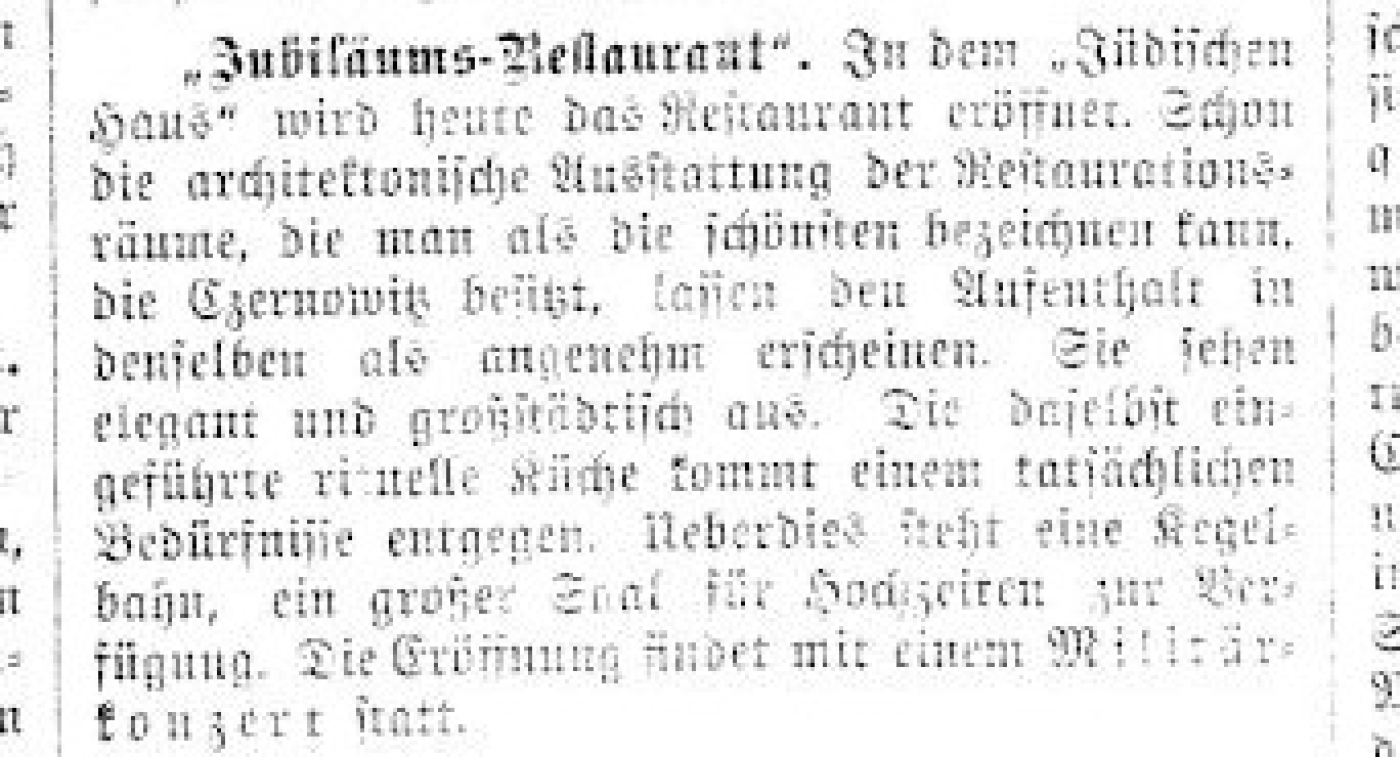
Today, the former Jewish House is a municipal cultural centre. The Jewish community still has a room here. On the ground floor is the Museum of Jewish History and Culture of Bukovina, opened in 2008.
Text: Markus Winkler