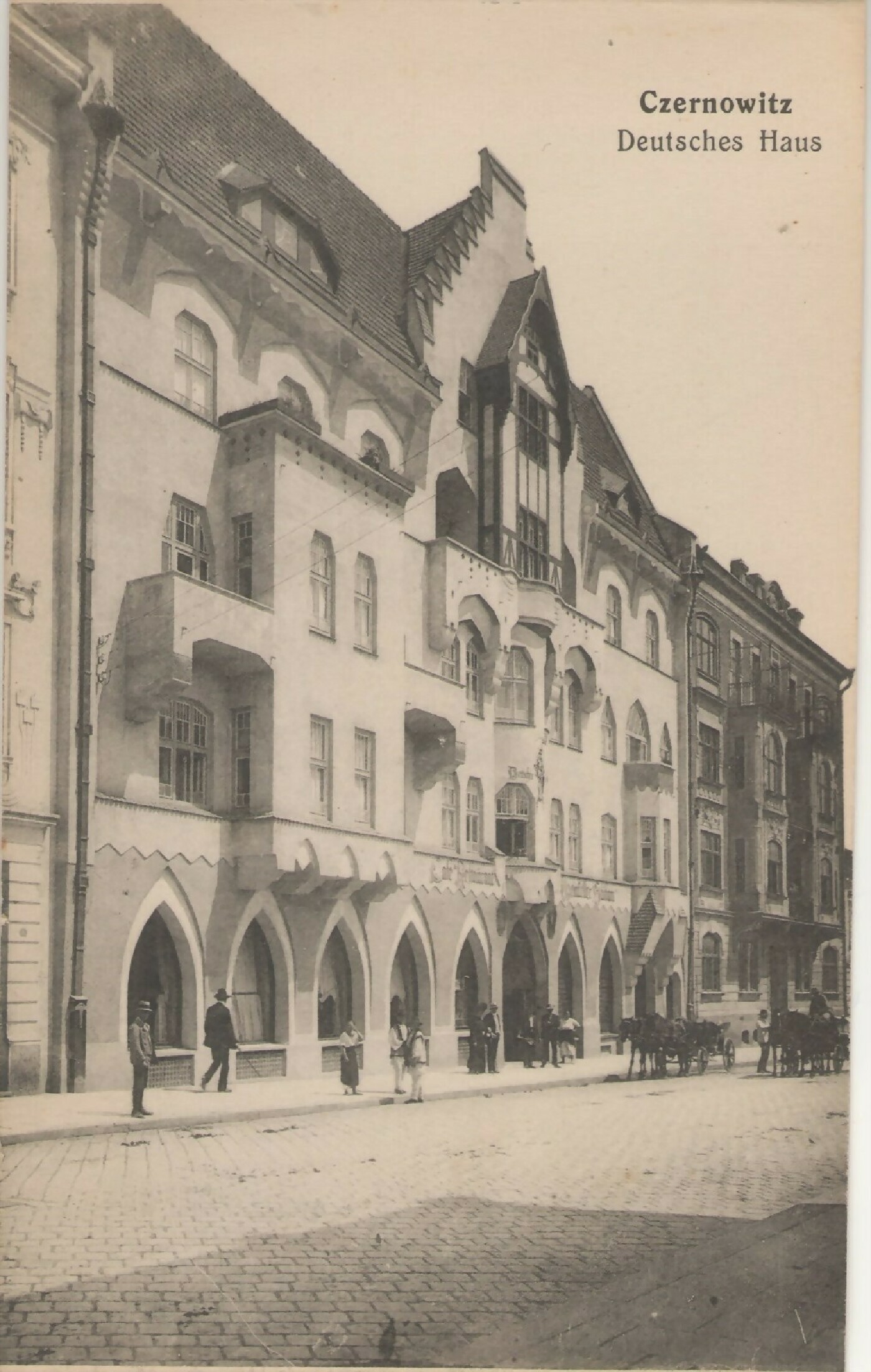
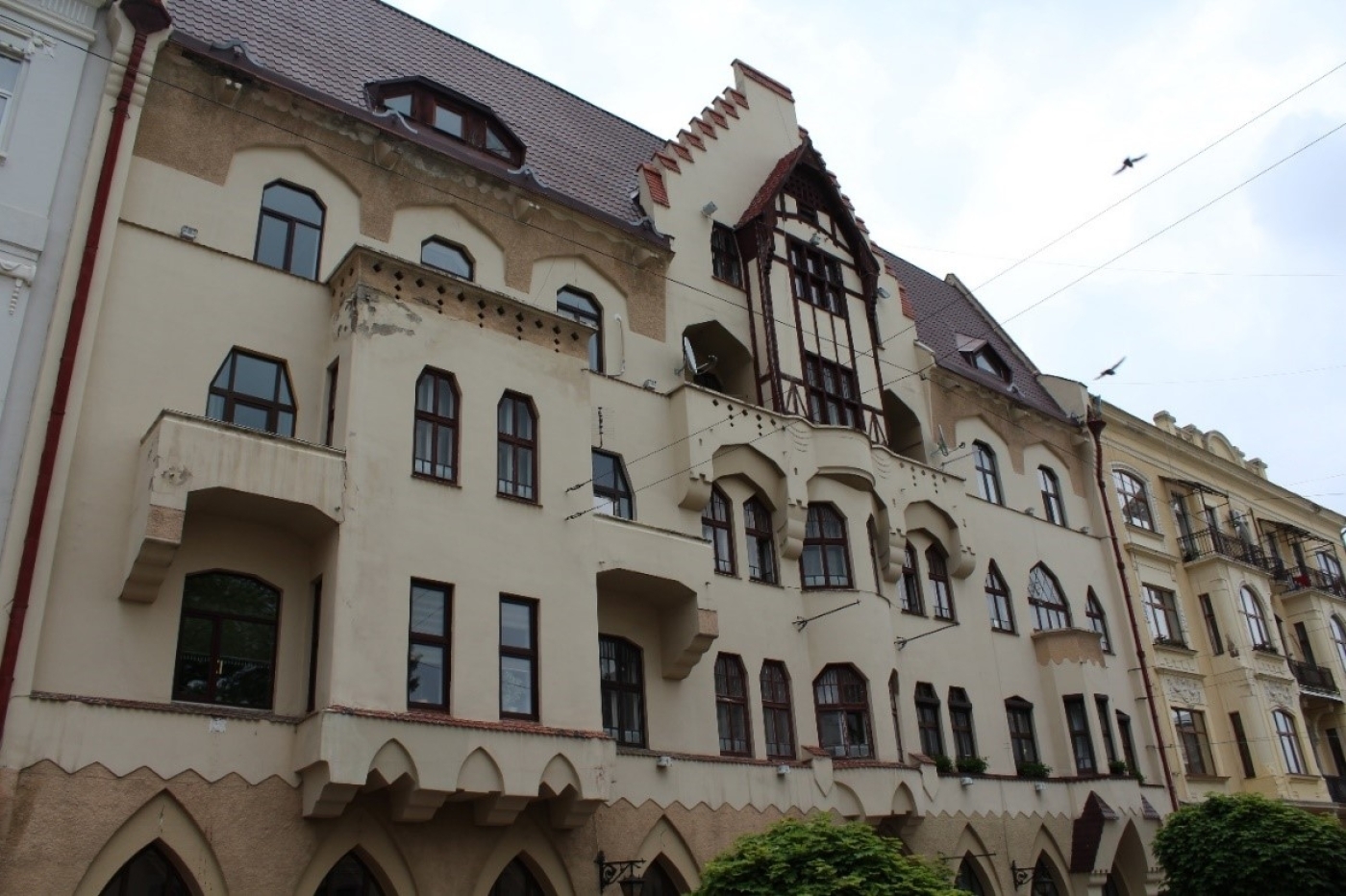
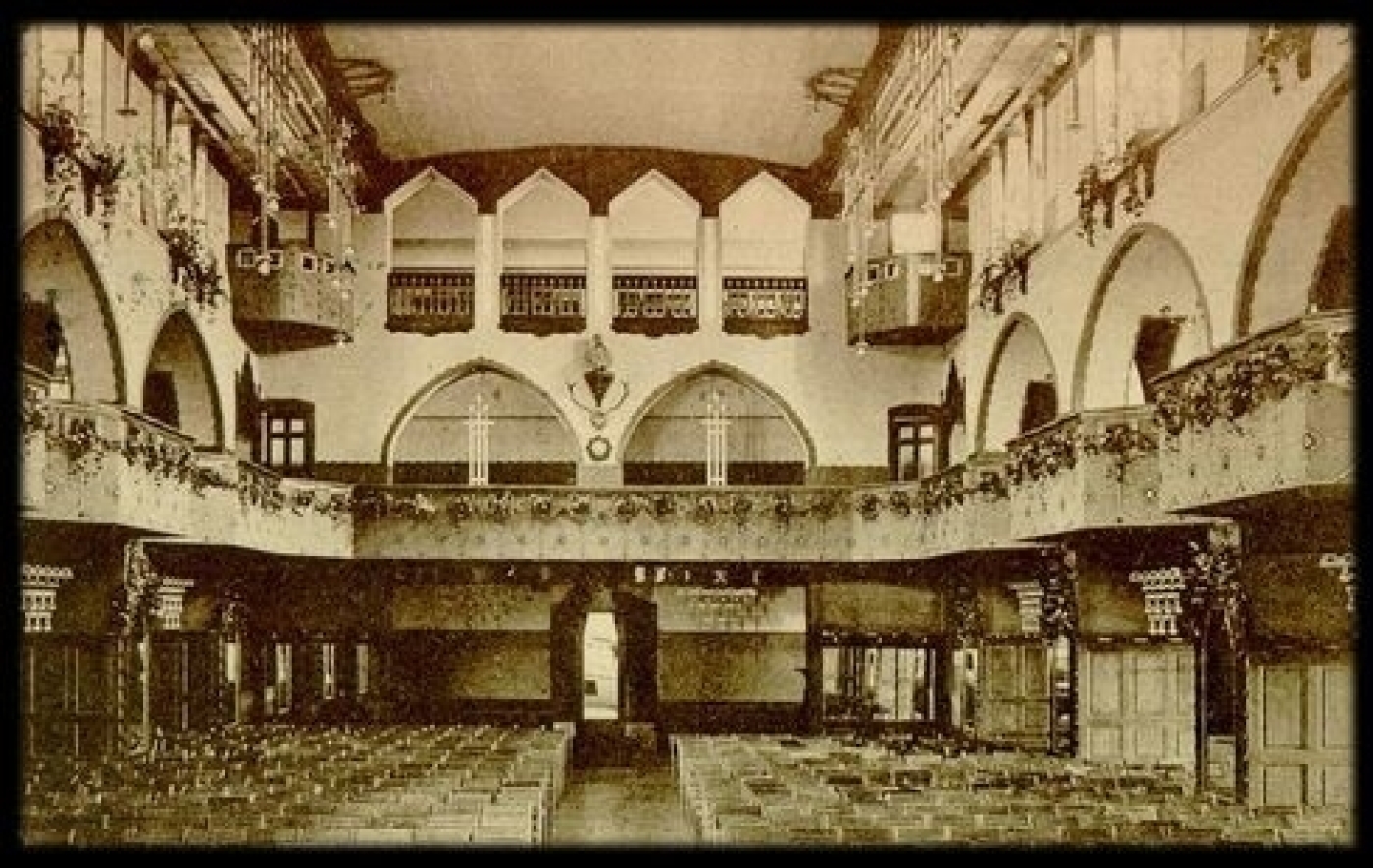
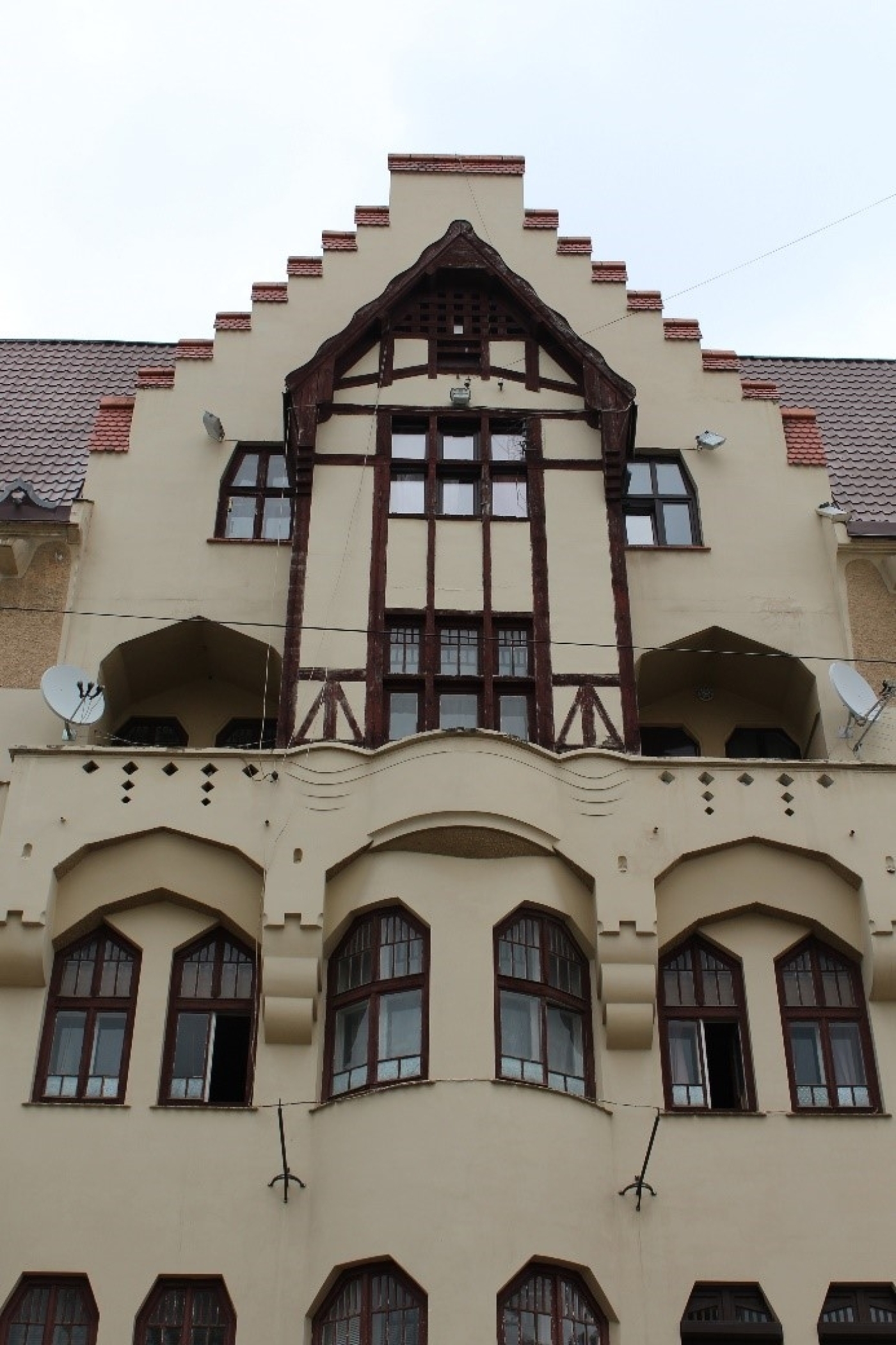
It is estimated to have cost around two million Kronen at the time. The bowling alley and restaurant were often used by members of the Polish House (Dom Polski) opposite. Other ethnic groups also used the premises for their events.
For a long time, the German House was the cultural centre of the Bukowina Germans. The first German House was bought in 1899 at Siebenbürgerstraße 40. Prior to this, the 'Association of Christian Germans', founded in 1897, had moved several times due to lack of space. As the number of members grew, the Association moved from Neue-Welt-Gasse 10 (now Schewtschenko-Street) to Franz Joseph Platz 4 (now cathedral square) and finally to Herrengasse 19 (now Olga-Kobyljanska-Street). To put an end to the constant relocations, the idea of a separate German House was born. The building, erected in 1910, was one of the last national houses to be built in Chernivtsi - after the Ukrainian National House (1887), the Romanian National House (around 1900), the Dom Polski (1905) and the Jewish House (1908). The Jewish Toynbee Hall followed in 1913.
In 1940, many Germans left Chernivtsi and settled in Germany, due to the 'Home to the Reich' resettlement programme – part of the border and friendship treaty between Germany and the Soviet Union. Foreign Minister Ribbentrop signed the treaty on the German side and Molotov on the Soviet side.
During the Soviet era, the German House lost its function and was no longer called the German House. It became a dormitory for students and teachers of the Faculty of Medicine. Later, private apartments were built here and the rooms that could not be used for living were used for other purposes. For example, a cinema called 'kino theatre ukraina' was opened in the ballroom. A children's cinema was also set up in another room. The generations that grew up in the Soviet Union hardly know any German. Their only motivation to learn German was to emigrate to Germany. However, when bureaucratic or other reasons made this impossible, this motivation no longer applied to them.
In 1991, all nationalities in Chernivtsi were given rooms in their original houses by the city. They can use them free of charge, paying only for utilities. From 2000 to 2010, the role of the house was to support residents with German roots and to take away their fear of admitting their German roots. The current role of the German House is to provide space for all nationalities to hold theatre performances, concerts and other events, as the current director and Honorary Consul of the Federal Republic of Germany, Alexander Schlamp, pointed out in an interview. The German House and its members can also act as a bridge between Ukraine and Germany. It is a place where understanding for both nationalities and countries can be found. In this way it is also possible to mediate on a political and economic level.
The current programme of the German House consists of several language courses and many events. There are five language courses you can take part in. One course is for children, one for teenagers and three for adults. These language courses are at levels A1-B1. The Deutsches Haus works closely with the Goethe-Institut for language tuition. Participants with German roots can attend the course free of charge.
One of the biggest events organised by the Deutsches Haus is the Festival of German Culture. It also organises an international theatre festival for young people and supports the Bukowina Phoenix youth theatre group. Many events take place outside the Deutsches Haus due to lack of space.
Text: Veronika Hilbertova
Link: www.facebook.com/DeutschesHausCzernowitz