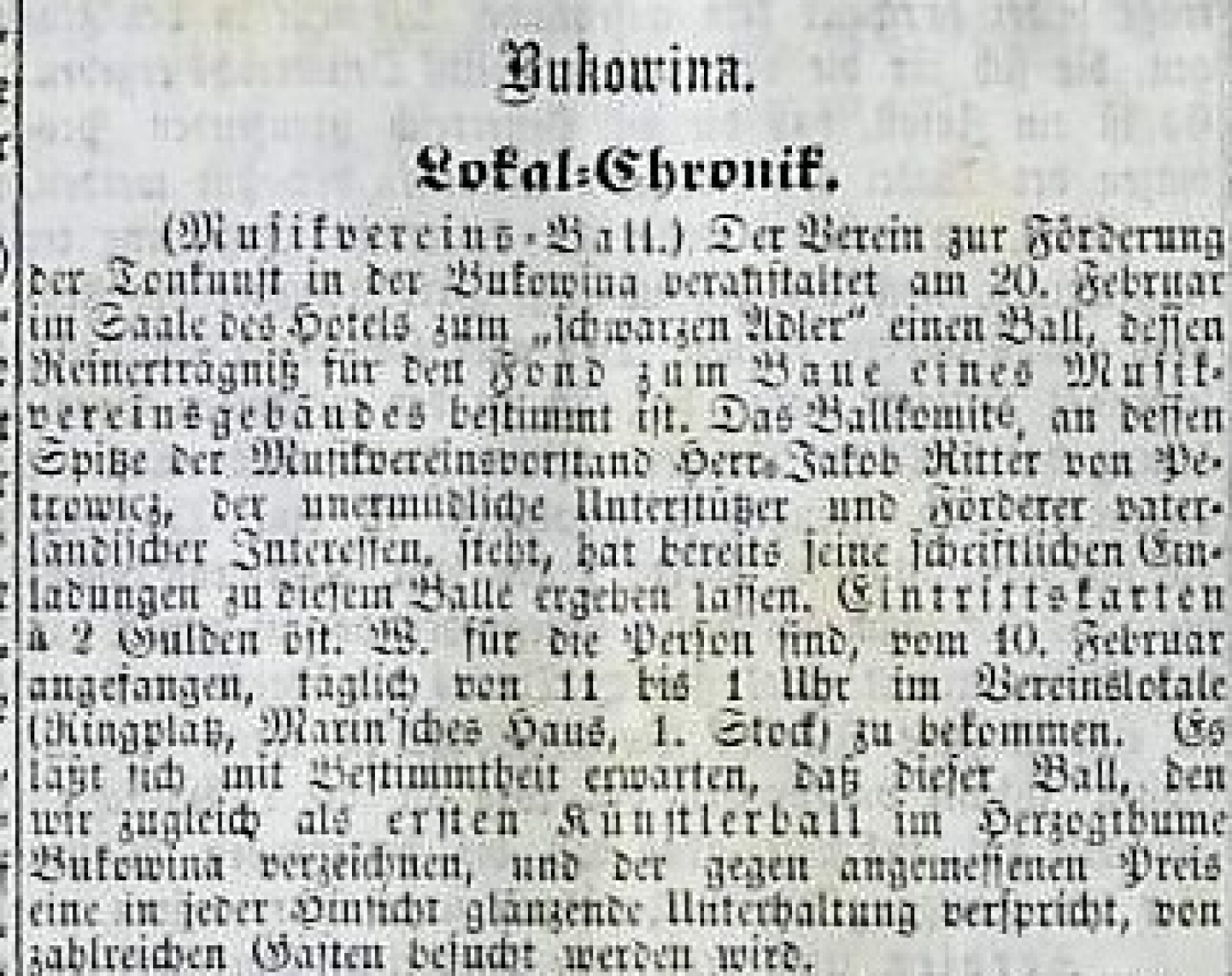
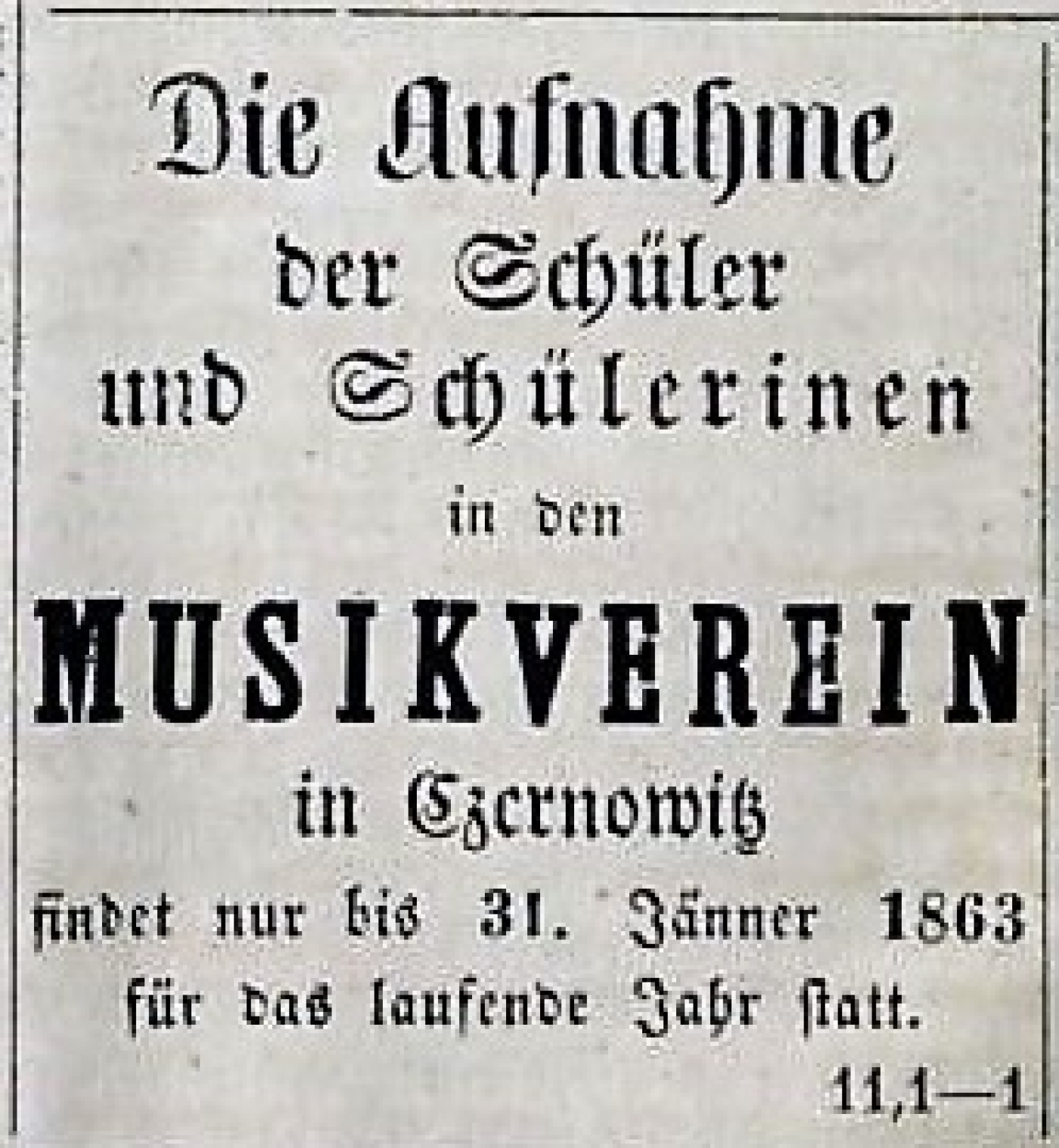
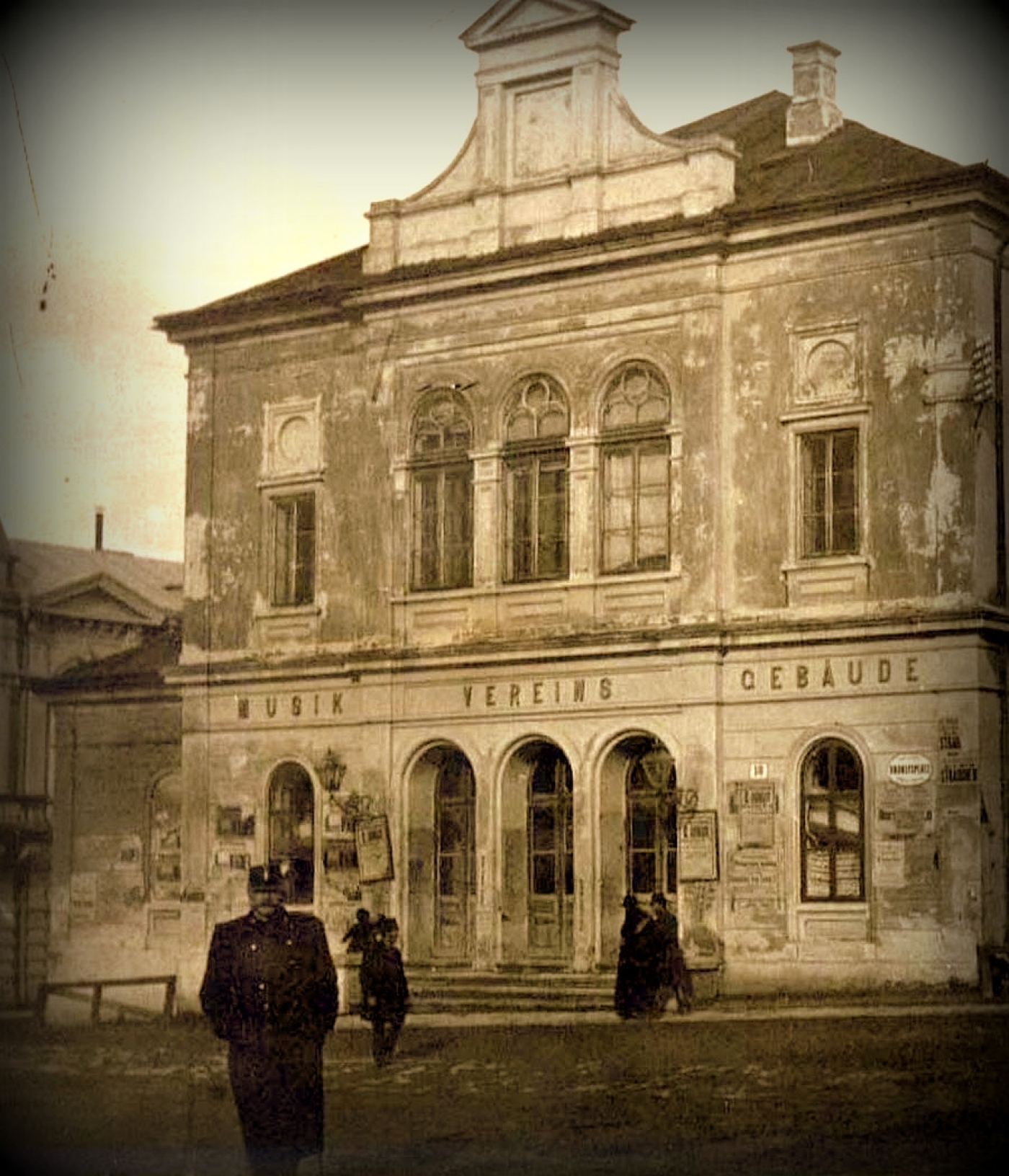
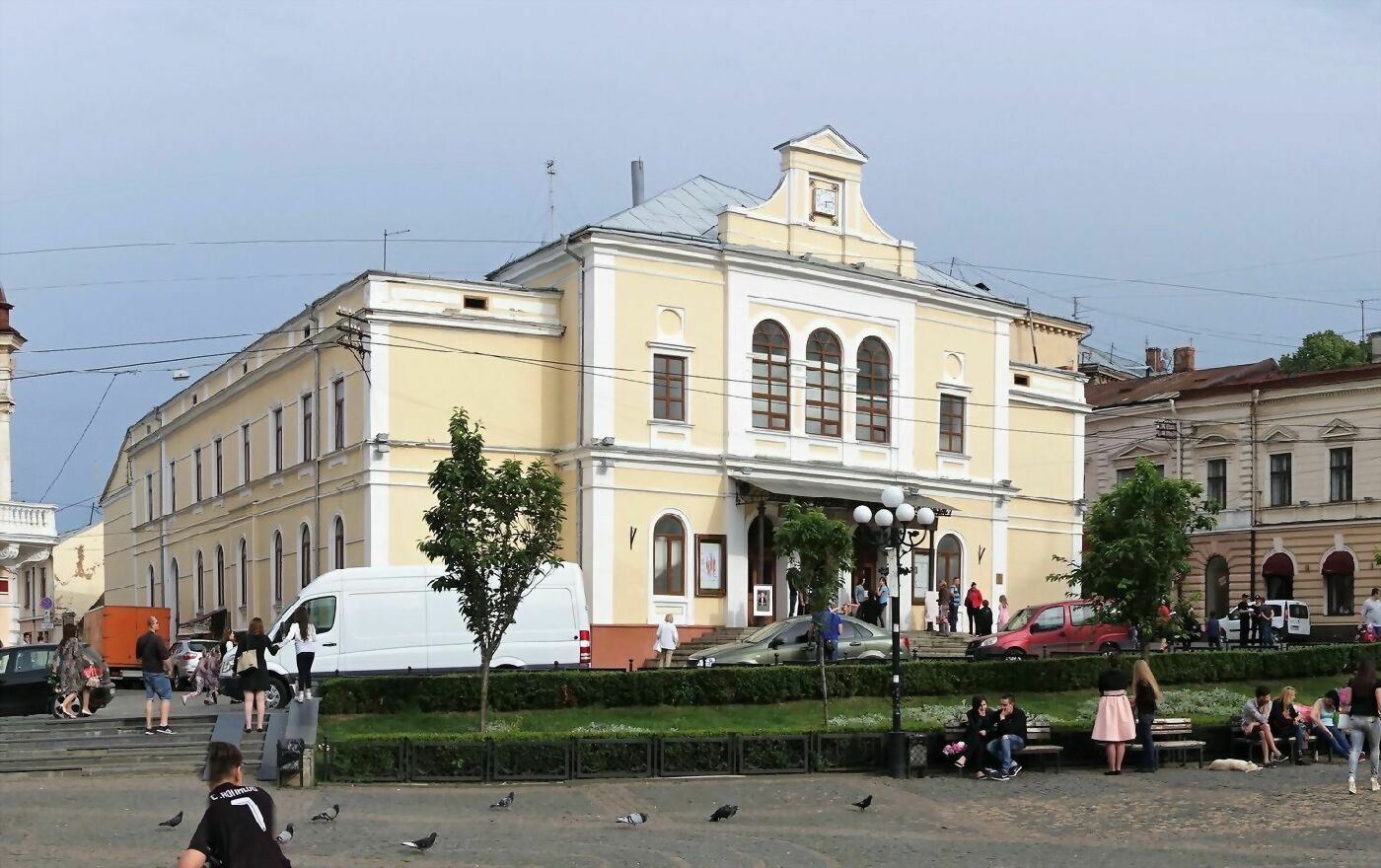
Until then, the society held its concerts and musical evenings in the concert hall of the Hotel Moldavie, the Schwarzer Adler Hotel, the Town Hall or rented other rooms in the town, such as Sarah Schütz's private rooms in Siebenbürger Strasse. The committee set up in 1868 to realise the plan to build a venue of their own included the mayor Otto Ambros Edler von Rechtenberg, members of the Chamber of Commerce and Industry Jakob Atlas, Josef Fechner, Naftali Tittinger, Heinrich Wagner and others. Karl Wechsler was elected chairman of the committee. After several attempts, the association was allocated a plot of land on Mehlplatz (from 1880 to 1918 Rudolfsplatz, until 1944 Piaţa Dacia, and until 1992 Plošča Peremohy, now Plošča Filarmoniï). Construction began in April 1876, according to a design by the architect Emil Vinzenz von Regius and under the supervision of Alois Burlitz. Originally, the building was to be lavishly decorated in Secession style, but as it was also to be used as a theatre, the available funds had to be used for the hall and stage as well. The society's ballroom was designed by the Viennese painter Karl Jobst, who was currently living in the archbishop's residence in Chernivtsi. The Musical Society began its activities in the new building in 1877. The ballroom had a very good reputation because of its acoustics. Many famous musicians and singers performed there: the Russian pianist and composer Anton Rubinstein, the Italian opera singer Gemma Bellincioni, the Austrian opera singer Lucie Weidt, the Austrian singer and actor Leo Slezak, the Ukrainian singer Solomija Krušelnycʾka, the French violinist Jacques Thibaud and the Russian opera singer Fedor Šaljapin.
Singers such as Josef Schmid and Orest Runak, Beatrix Sutter-Kottlar and Adele Krämer, the conductor Ludwig Rottenberg and the choirmaster Eusebius Mandyczewski studied at the Association's music school. The Association for the Promotion of Music in Bukovina existed until 1936. In 1940, the Soviet government established the Regional Philharmonic Orchestra in the building. During the Soviet era, Sidi Thal was one of the most famous singers of the Chernivtsi Philharmonic Orchestra.
Text: Kateryna Stetsevych
Materials:
- Ion Lihaciu: Die Entwicklung der Musikszene in der Bukowina. In: Acta Iassyensia Comparationis, 9/2011, S. 151-157